

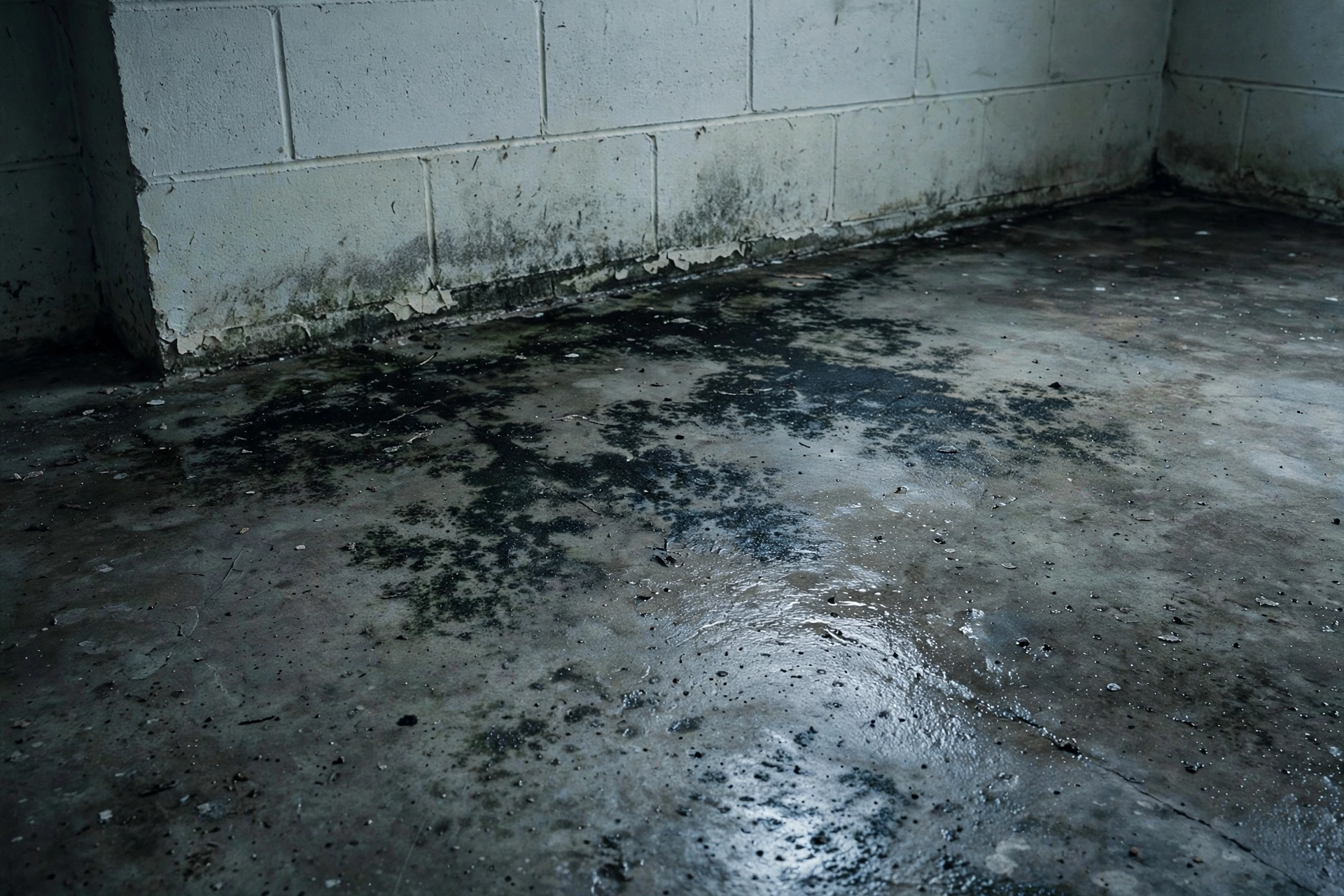
Concrete looks indestructible, so mold growing on a basement floor catches homeowners off guard. But concrete is porous: it wicks moisture up from the soil below, absorbs spills and condensation, and stays cool enough that humidity condenses on its surface in summer. Mold does not eat the concrete itself, but it feeds on the dust, dirt, and organic film sitting on top of it.
The fix has two parts, and skipping either one guarantees a repeat. First, clean the mold properly with the right methods for a porous mineral surface. Second, address the moisture: seal the concrete, control the humidity, and fix whatever is delivering water to the floor in the first place.
This guide covers the whole job: why concrete grows mold, how to tell mold from the white powdery efflorescence that looks similar, safe cleaning methods, sealing options with realistic costs, and the humidity control that keeps it from coming back. If your basement walls have growth too, read our guide to mold on basement walls alongside this one.
Why concrete basement floors grow mold
Concrete’s porosity is the root cause. A slab on damp soil draws moisture upward through capillary action, a slow wicking that keeps the concrete’s pores humid even when the surface looks dry. In summer, warm humid air hits the cool slab and condenses, adding surface moisture on top of the wicking from below.
Mold needs an organic food source, and a bare concrete floor always has one: household dust, tracked-in dirt, and the film of organic matter that accumulates in any basement. Growth appears in patches under stored items, along walls with poor airflow, and in corners where condensation collects.
Finished basements hide the problem longer: flooring laid over a damp slab traps moisture, and mold grows unseen underneath. A musty smell with no visible growth often means the concrete below is the source.
Efflorescence vs mold: telling them apart
Before treating anything, make sure you know what you are looking at. Efflorescence is a white, powdery deposit of mineral salts left behind when water moves through concrete and evaporates. It is common on basement floors, it is not mold, and it is not a health concern.
The two look different up close. Efflorescence is white or light gray, powdery, and crumbles to dust when rubbed. Mold is typically black, green, brown, or gray, often fuzzy or slimy, and it smears rather than crumbles. If it wipes off as powder, it is likely efflorescence; if it smears with a musty smell, it is likely mold.
Efflorescence still means water has been moving through the concrete, so heavy deposits alongside mold point to an active moisture problem, not a one-time spill. Brush it off dry, but do not mistake its removal for solving the mold issue.
Prep and safety before you start cleaning
Clear the work area completely. Move stored items out, since mold often hides under boxes and shelving, and discard anything porous that shows growth. Sweep or HEPA-vacuum the floor first so the wet cleaning does not turn loose dust and spores into mud.
Gear up as for any mold cleanup: N95 respirator, sealed goggles, rubber gloves. Scrubbing and pressure washing throw contaminated water into the air, so keep the respirator on throughout. For growth over about 10 square feet or poor ventilation, consider a professional.
Protect what should not get wet: cover the bottom of drywall and nearby wood framing with plastic sheeting, and plan your drainage, since cleaning a basement floor produces a lot of dirty water. A wet vacuum and a floor drain or sump pit handle it; mopping it toward a corner does not.
Cleaning mold from concrete, step by step
Concrete takes aggressive cleaning that would destroy drywall, so the approach here is more physical than chemical.
1. Scrub with detergent and water
Mix a heavy-duty detergent with hot water and scrub the affected areas with a stiff deck brush. Concrete’s texture holds mold in its pores, so real effort matters; a light wipe does nothing. Work in sections and extract the dirty water with a wet vacuum as you go so you are not just spreading the slurry around.
2. Treat with an antimicrobial
After the mechanical cleaning, apply a concrete-safe antimicrobial and let it dwell for the label’s specified time. For a comparison of the common options, see our Concrobium vs bleach breakdown and our roundup of the best mold killers. Avoid bleach as the primary treatment: on porous concrete it cleans the surface while the water component soaks in and the roots survive.
3. Rinse, extract, and dry fast
Rinse with clean water and extract it fully with the wet vacuum; residual detergent can interfere with sealer adhesion, so rinse twice if you plan to seal. Then get airflow moving immediately: a wet slab left to air-dry in a still basement invites regrowth. For heavy, widespread growth, a pressure washer at 1,500 to 2,000 PSI with a fan tip blasts mold from surface pores faster than scrubbing.
Drying the slab and choosing a sealer
After cleaning, dry the floor aggressively. Run fans across the surface and a dehumidifier in the basement for several days, aiming for indoor humidity in the 30 to 50 percent range recommended by the EPA’s indoor air quality guidance. The slab is ready for sealer when a tape test shows no trapped dampness: tape a 2-foot square of plastic to the floor for 24 hours, and if condensation forms underneath, the slab is still releasing moisture.
Penetrating sealers soak into the concrete’s pores and block moisture vapor while remaining invisible; silane or siloxane products run roughly $0.50 to $1.50 per square foot in material for DIY application. Film-forming sealers and waterproof coatings, like epoxy or basement floor paints, create a barrier on top of the slab at roughly $1 to $3 per square foot DIY, or $3 to $7 per square foot professionally installed.
Be honest about what a sealer can do. A penetrating sealer reduces vapor transmission and makes the surface less hospitable to mold, but it will not stop liquid water pushing up through the slab under hydrostatic pressure. If water pools on the floor during rain, the problem is drainage or a high water table, and no coating will hold back that pressure for long.
Humidity control and when to call a waterproofing pro
The cleaning and sealing are wasted if the basement stays humid. A basement dehumidifier sized for the space, typically 50 to 70 pints per day, running with a drain hose to a sump or floor drain so it never shuts off on a full bucket, is the single most effective long-term measure. Keep relative humidity below 60 percent at all times, below 50 percent if you can.
Eliminate the microclimates where mold starts: store belongings in plastic bins on shelving, not cardboard boxes on the floor, and leave an air gap behind items against walls. In summer, avoid over-cooling the basement relative to incoming humid air, since a cold slab plus warm moist air is exactly what causes condensation.
Some floors stay wet no matter how much you clean and seal, and that is the signal to stop treating symptoms. Call a basement waterproofing contractor if water pools on the floor during or after rain, if the tape test shows heavy condensation week after week, or if water seeps up through cracks in the slab. Interior perimeter drains with a sump pump solve the problem that cleaning never will. After flooding events, the EPA’s flooding resources and the CDC’s mold cleanup tips cover cleanup priorities and when professional help is warranted.
Frequently Asked Questions
Is mold on a concrete floor dangerous?
It carries the same health concerns as mold anywhere: allergic reactions, respiratory irritation, and problems for people with asthma or weakened immune systems. It also signals excess moisture that damages stored belongings and flooring. The growth is a symptom; the moisture is the real problem.
Can I paint over mold on concrete with waterproof paint?
Only after fully cleaning and drying the concrete first. Coatings applied over active mold trap it underneath, and growth can continue behind the coating or push it off the surface. Clean, treat, dry, then coat clean concrete.
Will a dehumidifier alone stop mold on my basement floor?
It stops a lot of it. Keeping basement humidity below 50 percent prevents condensation on the cool slab and starves surface mold of moisture. But a dehumidifier cannot fix liquid water wicking up through the slab or pooling during rain; those need drainage or waterproofing.
How do I tell white powder on my floor is mold or efflorescence?
Rub it between your fingers. Efflorescence is white, powdery, and crumbles to dust with no smell. Mold is usually darker, smears rather than crumbles, and often smells musty. Heavy efflorescence still means water is moving through the concrete.
How much does it cost to seal a concrete basement floor?
DIY penetrating sealers run about $0.50 to $1.50 per square foot in materials; DIY epoxy or waterproof coatings run $1 to $3 per square foot. Professional epoxy coating typically costs $3 to $7 per square foot. A 1,000-square-foot basement therefore ranges from roughly $500 DIY to several thousand professionally done.
Should I remove flooring to check for mold on the concrete underneath?
If a finished basement smells musty with no visible source, yes. Pull back carpet in a corner or lift a plank to inspect the slab. Mold under flooring will not resolve on its own, and the flooring usually needs to come up for the concrete to be cleaned, dried, and sealed properly.
What to do next
Identify what is on the floor: powdery efflorescence or actual mold. Clear the area, gear up, and work the sequence: HEPA vacuum, detergent scrub, antimicrobial treatment, rinse and extract, then dry aggressively. Only seal once the slab passes the tape test.
Then commit to the long game: a properly sized dehumidifier on a drain hose, storage off the floor, and humidity under 50 percent. If water keeps arriving despite all that, get a waterproofing contractor involved before the next rainy season, and lean on our preventing basement mold checklist in the meantime.