

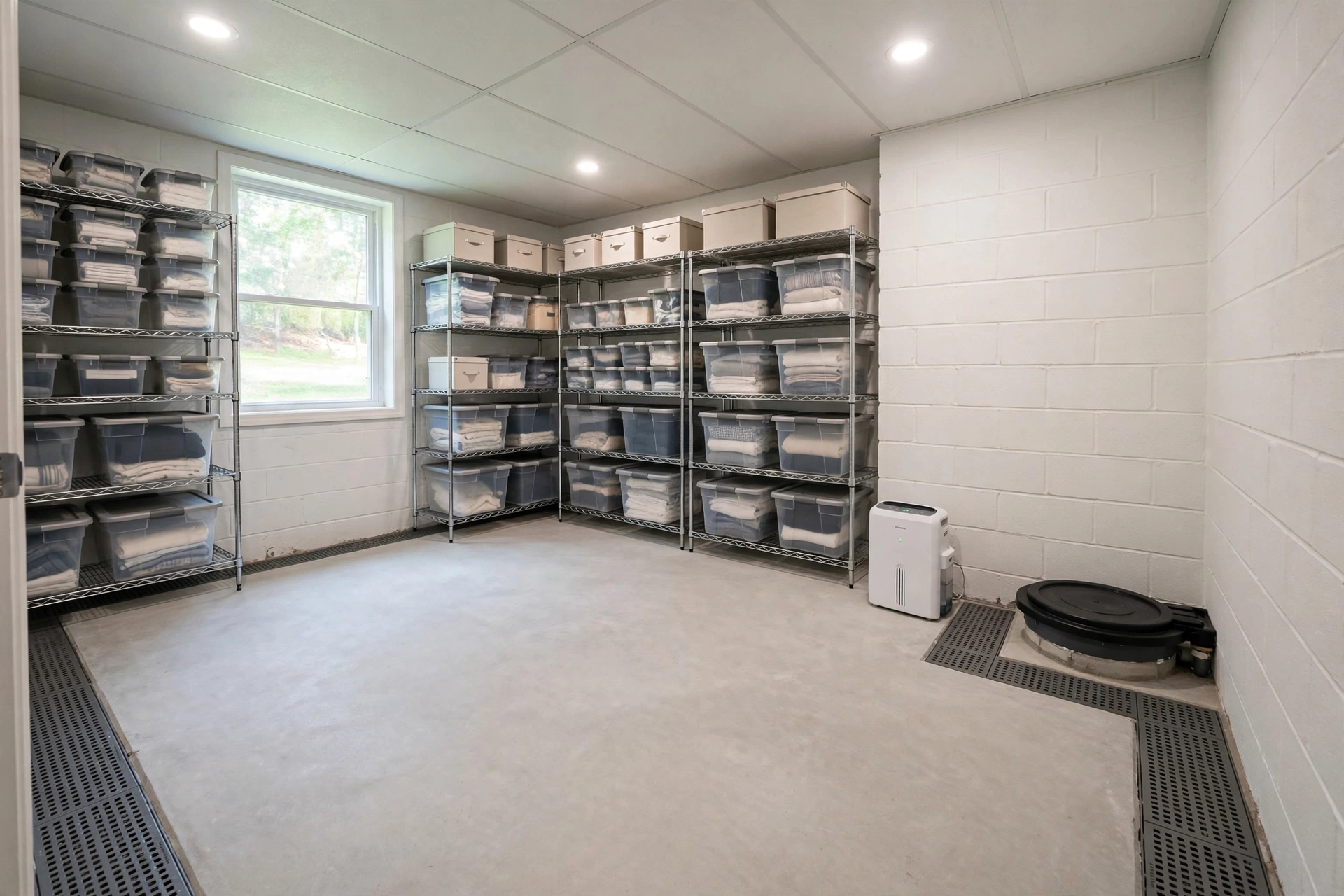
Basements are where mold goes to thrive. They are cool, often damp, full of organic dust and cardboard, and ventilated worse than any other part of the house. If your basement smells faintly musty every summer, that is not “just how basements smell.” It is an early warning.
Preventing basement mold comes down to three things: humidity, drainage, and airflow. Fix all three and mold has nowhere to get started. This guide gives you target numbers, concrete fixes, and the warning signs that mean you need more than a dehumidifier.
Why basements are mold magnets
Concrete is porous. It wicks moisture from the surrounding soil straight through foundation walls and floors, a process called vapor transmission. Add summer humidity condensing on cool basement walls, minor seepage after rain, and poor air circulation, and you have a space that sits at 65 to 75 percent relative humidity for months. Mold needs roughly 60 percent humidity on a surface to get going, so most untreated basements live right in the growth zone.
The EPA’s guidance on mold and moisture in homes makes the core point clearly: control moisture and you control mold. Everything below is just that principle applied to basements. If you are coming off an actual water event, start with our post-water-damage mold prevention checklist first, then come back here for the long-term fixes.
Fix 1: Keep humidity under 60 percent, always
This is the single highest-impact thing you can do. Mold growth drops off sharply when relative humidity stays below 60 percent, and the EPA recommends keeping indoor humidity between 30 and 50 percent.
Measure first
Buy a digital hygrometer (about $15) and put it at chest height in the middle of the basement, away from the dehumidifier’s exhaust. Check it morning and evening for a week. If readings regularly top 60 percent, you have a problem worth fixing, not just monitoring.
Size your dehumidifier correctly
An undersized dehumidifier running constantly is the most common failure I see. Match capacity to your space and dampness level: a moderately damp 1,000 sq ft basement typically needs a 30 to 50 pint unit; a very damp or musty one needs 50 pints or more. Set the humidistat to 45 to 50 percent and plumb the drain hose to a floor drain, sink, or condensate pump so it runs continuously without you emptying buckets.
Our basement dehumidifier guide walks through sizing, features, and setup in detail, including when a portable unit is not enough and you need a whole-house or dedicated crawlspace model.
Stop adding moisture
- Vent the clothes dryer fully outdoors, not into the basement. A single load dumps gallons of water vapor into the air.
- Do not hang laundry to dry in an unfinished basement unless a dehumidifier is running.
- Fix plumbing drips, sweating pipes (insulate cold water lines), and sump pit evaporation with a sealed sump cover.
Fix 2: Keep water away from the foundation
No dehumidifier can outrun active water entry. If water is coming in, humidity control is a bandage. If water already got in, start with our steps to prevent mold after water damage, then use the drainage fixes below to keep it from happening again. Walk through them in order, cheapest first:
- Grade the soil so it slopes away from the foundation: at least 6 inches of fall in the first 10 feet. This alone fixes a surprising share of seepage.
- Extend downspouts 6 to 10 feet from the house. Roof water dumping at the foundation is the number one cause of basement seepage I encounter.
- Clean gutters twice a year. Overflowing gutters pour water exactly where you do not want it.
- Seal obvious cracks in foundation walls with hydraulic cement or epoxy injection for non-structural hairline cracks. Wide, horizontal, or growing cracks need a structural evaluation, not caulk.
- Test your sump pump before every rainy season: pour a bucket of water in the pit and confirm it pumps out and the check valve holds. Consider a battery backup; storms knock out power exactly when you need the pump most.
If you see efflorescence (white mineral crust) on walls, that is proof water is moving through the concrete. It is not mold, but it is a flashing sign that moisture is present and mold conditions exist. The CDC’s mold prevention guidance after wet weather events reinforces the same point: dry it, then fix the source.
Fix 3: Get air moving
Still air lets moisture sit on cool surfaces long enough to condense. Basements need deliberate air circulation:
- Keep at least a few inches of gap between stored items and exterior walls. Boxes packed tight against concrete trap humid air.
- Run a small circulating fan on low, or keep the HVAC fan in “on” rather than “auto” during humid months so air keeps mixing.
- If you have basement supply vents, do not close them all in summer. Conditioned air is dehumidified air.
- In finished basements, a dedicated return vent improves circulation dramatically and costs little during a remodel.
One caution: do not ventilate a basement with hot, humid outdoor air in summer thinking you are “airing it out.” Bringing 85-degree humid air into a 65-degree basement causes condensation on walls and pipes, which is worse than the still air you started with. Ventilate with outdoor air only when it is cooler and drier than the basement.
Choose materials that do not feed mold
If you are finishing or refinishing a basement, material choice is prevention that lasts decades:
- Use paperless drywall (fiberglass-faced) instead of standard paper-faced drywall. Paper facing is mold candy.
- Choose inorganic insulation: rigid foam board or closed-cell spray foam instead of fiberglass batts, which trap moisture against the foundation.
- Consider luxury vinyl plank or sealed concrete over carpet. Wall-to-wall carpet on a basement slab is the highest-risk flooring choice in the house.
- Use mold-resistant paint on masonry walls as a supplement, not a solution. It buys time; it does not fix moisture.
The EPA’s indoor air quality guidance covers moisture control strategies that apply well beyond basements, worth a read if anyone in the home has allergies or asthma.
Warning signs you need more than DIY
- Water actively entering during rain, even small amounts, after you have fixed grading and downspouts.
- Musty odor that returns within days of cleaning, which usually means hidden growth inside walls or under flooring.
- Visible mold covering more than about 10 square feet.
- Chronic humidity above 65 percent despite a properly sized dehumidifier running constantly.
- Foundation cracks that are horizontal, stair-stepped in block walls, or visibly widening.
Any of these means the moisture source is winning. A waterproofing contractor or structural engineer is the next call, not a bigger dehumidifier. To budget for that call, see our breakdown of basement waterproofing costs and what drives them. And if you have just dealt with a flooding event, our post-water-damage checklist covers the urgent first-48-hour steps.
Seasonal maintenance routine
- Spring: clean gutters, extend downspouts, test sump pump, check grading after winter settling.
- Summer: dehumidifier on and draining, hygrometer checked weekly, dryer vent inspected.
- Fall: seal foundation cracks before freeze-thaw widens them, disconnect hoses, check window wells.
- Winter: watch for condensation on rim joists and cold water lines; insulate sweating pipes.
The EPA’s brief guide to mold and moisture is a good companion reference for the why behind each of these habits.
Frequently Asked Questions
What humidity level prevents mold in basements?
Keep relative humidity below 60 percent at all times, ideally 30 to 50 percent. Mold growth slows dramatically under 60 percent, but the surface humidity in a cool basement can be higher than the room reading, so aim for the low 40s as a safety margin.
Will a dehumidifier alone stop basement mold?
It handles airborne humidity, which solves many cases. It cannot fix active water entry, condensation from poor insulation, or moisture wicking through the slab. If the dehumidifier runs constantly and humidity stays high, the water is coming from somewhere the unit cannot reach.
Is the white powdery stuff on my basement walls mold?
Usually not. White, crusty, crystalline deposits are efflorescence: mineral salts left when water evaporates through concrete. It is not mold, but it proves water is moving through the wall, which means mold conditions exist nearby.
Should I run my basement dehumidifier in winter?
Only if humidity readings say so. Cold winter air is dry, and most basements drop below 50 percent naturally. Running a dehumidifier in a cold basement can freeze its coils. Monitor with a hygrometer and run it as needed.
Does painting basement walls with waterproof paint stop mold?
Waterproof and mold-resistant paints slow moisture and resist surface growth, but they do not stop water pressure from outside or humidity in the air. Treat paint as a supplement to drainage and dehumidification, never the whole plan.
What to do next
Start with the hygrometer. You cannot fix what you are not measuring, and a week of readings will tell you whether you need a dehumidifier, drainage work, or both. Tackle grading and downspouts this weekend (cheap, high impact), then size a dehumidifier properly with our 2026 dehumidifier guide. Basements stay dry through systems, not luck, and these three fixes are the system.