

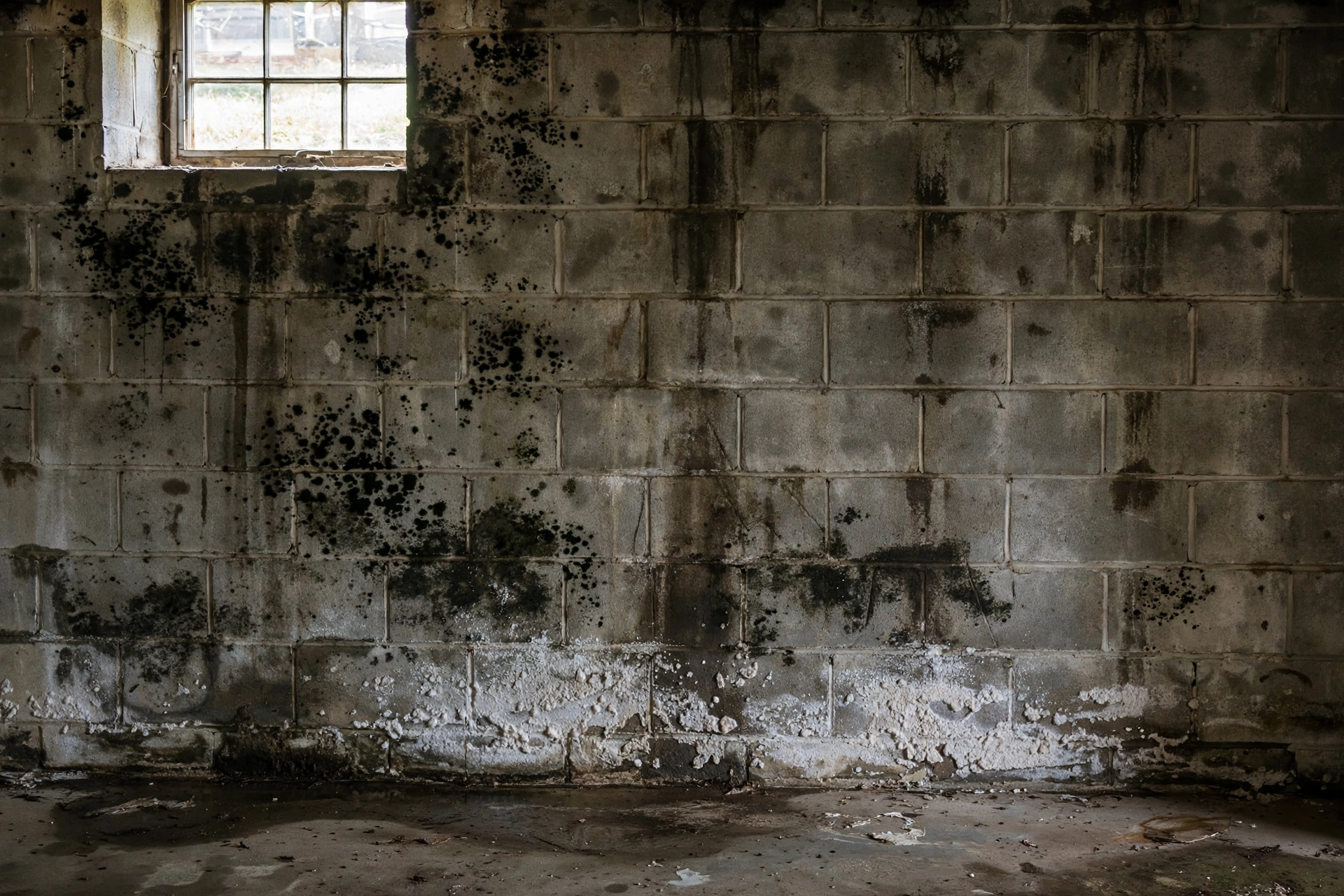
Those dark spots creeping up your basement wall are hard to ignore once you have seen them. Maybe they started as a few speckles near the floor and now they are spreading in patches. Maybe the whole lower wall looks dusty and discolored. Either way, mold on basement walls is one of the most common moisture problems in American homes, and it is very fixable once you understand what is feeding it.
Concrete and block walls do not rot, which tricks people into thinking the mold is harmless. It is not feeding on the concrete itself. It is feeding on the dust, dirt, paint, and organic debris on the concrete, plus any wood, drywall, or cardboard touching the wall. This guide covers why basement walls grow mold, how to clean them safely, and the prevention work that keeps the spots from returning.
What causes mold on basement walls
Every case comes down to the same equation: moisture plus food plus time. Here are the usual moisture sources, roughly in order of how often they are responsible.
Water wicking through the foundation
Concrete and concrete block are porous. Groundwater pushes against the foundation (hydrostatic pressure) and moisture migrates through the wall as vapor or liquid. You will see the evidence as darkening at the base of the wall, white mineral crust (efflorescence), and paint that bubbles or peels from below. Poor exterior drainage, short downspouts, and grading that slopes toward the house all make this worse.
Condensation
In summer, warm humid air hits cool basement walls and condenses, just like a cold drink sweating on a hot day. Walls below grade stay in the 55 to 65 degree range, so any indoor humidity above about 60 percent will condense on them. This is why mold often appears in summer even in basements with no leaks at all.
Plumbing leaks and past floods
A slow drip from a pipe running along the wall, a water heater relief valve discharge, or a flood that was mopped up but never truly dried can leave the bottom of the wall damp for weeks. Remember that mold can start growing within 24 to 48 hours of materials getting wet, so even a brief event matters if drying was incomplete.
Finished walls hiding the problem
In finished basements, mold often grows on the back of the drywall or on the wood framing touching the concrete, completely out of sight. The first visible sign might be a musty smell or staining at the baseboard. If your basement is finished and smells musty, read our musty basement smell guide alongside this one, since the cleanup approach differs when drywall is involved.
How to identify what you are looking at
Not every dark spot is mold. Efflorescence, the white crusty mineral deposit left by evaporating water, is often mistaken for mold but it is just salt, and it brushes off as a dry powder. Dirt splatter near the floor, old paint discoloration, and rust stains are other lookalikes.
Mold on concrete usually appears as black, dark green, or brown spots and patches, sometimes with a slightly fuzzy or slimy texture. It often follows a pattern: worst near the floor, in corners, and behind stored items where air does not circulate. If you are unsure, the pattern and location usually tell the story. Efflorescence is white and crystalline; mold is dark and organic-looking. When in doubt, treat it as mold and clean accordingly. The cleaning process is harmless to concrete either way.
How to clean mold off basement walls safely
Concrete and block are non-porous enough that surface mold can usually be cleaned rather than requiring material removal, which is good news. The bad news is that the cleaning only sticks if the moisture problem gets fixed too.
Gear up first
Even a straightforward wall scrubbing releases a cloud of spores. Wear an N95 respirator, goggles, and gloves, and ventilate the area if you can. Follow the CDC’s safety recommendations for mold cleanup. Keep children and pets out of the work area.
The cleaning process
- Clear the wall. Move everything at least 3 feet back. Bag and discard moldy cardboard; HEPA-vacuum the wall surface first to capture loose spores.
- Scrub with detergent. Mix a standard household detergent with water and scrub the affected areas with a stiff brush. The EPA’s cleanup guidance stresses physical removal over any particular chemical, and on concrete that means elbow grease.
- Rinse and repeat. Wipe or rinse the wall and check your work with a bright light at a low angle. Residual staining that does not scrub off is usually just staining, not live growth, but any fuzzy or raised material needs another pass.
- Dry completely. Run fans and a dehumidifier until the wall is fully dry. Do not paint or seal over a damp wall.
A note on bleach: it is not the right tool for this job. Bleach can discolor mold on hard surfaces without reliably killing roots in porous spots, and on concrete it does nothing about the moisture driving the growth. Detergent, scrubbing, and drying outperform it here. Our black mold removal guide goes deeper on cleaner choices and protective gear for bigger jobs.
Know when to stop and call a pro
DIY is reasonable for surface mold on accessible concrete covering less than about 10 square feet. Call a professional if the growth covers a large area, if it is inside finished walls, if there is any sewage involvement, or if anyone in the home has significant respiratory issues. Pros bring containment, negative air, and commercial drying equipment that changes the outcome on bigger jobs.
Prevention: keeping it from coming back
Cleaning without prevention is a recurring appointment. Here is the prevention stack, in order of impact.
- Fix exterior water first. Extend downspouts at least 6 feet from the foundation, fix grading so soil slopes away from the house, and keep gutters clean. Most basement wall moisture starts outside.
- Control indoor humidity. Keep basement relative humidity between 30 and 50 percent with a properly sized dehumidifier and continuous drainage. This single step prevents most condensation-driven mold.
- Improve air circulation. Do not pack storage tight against walls. Leave a few inches of air gap so walls can breathe and dry. A small fan on a timer beats stagnant air.
- Choose basement-friendly materials. If you finish the basement, use inorganic materials where possible: no paper-faced drywall against concrete, no carpet pad on the slab. There are mold-resistant drywall products, but the assembly design matters more than any single product.
- Seal penetrations. Caulk around pipes, wires, and vents where they pass through foundation walls. Every gap is a path for humid air and occasional water.
Waterproof paints and sealers have a supporting role for minor vapor transmission, but they are not a fix for active water entry. Apply them only to clean, fully dry walls after the real drainage work is done.
How this differs from mold elsewhere in the house
Basement wall mold is usually a moisture-management problem rather than a leak-repair problem, which makes it different from, say, mold in the attic (typically a ventilation issue) or bathroom mold (typically a ventilation plus splash issue). The basement version responds best to the unglamorous fundamentals: drainage, dehumidification, and airflow. Get those right and concrete walls stay clean for years.
Frequently Asked Questions
Is mold on basement concrete walls dangerous?
It can trigger allergies and respiratory irritation, especially in sensitive people, and it signals a moisture problem that damages the house over time. The mold itself is less structurally threatening on concrete than on wood or drywall, but the underlying dampness still needs addressing.
Can I just paint over mold on basement walls?
No. Paint over active mold seals in moisture and the growth continues underneath, eventually blistering the new paint. Clean, dry, and fix the moisture first. Mold-resistant primer is a reasonable final step on a properly prepared wall, never a shortcut.
Why does the mold keep coming back in the same spot?
Because the moisture source was not fixed. Recurring growth in one location almost always means water is still arriving there, through the wall, from condensation, or from a nearby leak. Track the water before cleaning a third time.
Does efflorescence mean I have mold too?
Not necessarily, but it proves water is moving through the wall, which creates the conditions mold needs. Where you find heavy efflorescence, look closely for mold nearby, especially at the wall-floor joint.
Should I use a mold-killing spray after scrubbing?
An antimicrobial treatment after thorough cleaning and drying is fine as a finishing step, but it is optional. The scrubbing, drying, and moisture control do the real work. No spray compensates for a wall that stays damp.
Bottom line
Mold on basement walls looks alarming but it is one of the more straightforward mold problems to solve: scrub it off properly, dry the wall completely, then fix the moisture that fed it, starting outside with drainage and finishing inside with a dehumidifier holding 30 to 50 percent humidity. If the growth is extensive, hidden behind finished walls, or keeps returning despite your efforts, bring in a professional rather than fighting the same wall every season. And if the musty smell lingers after the walls are clean, our guide to eliminating musty basement smell for good covers the rest of the odor sources. For protective gear and step-by-step safety, the EPA’s mold resources are worth bookmarking before you start.