

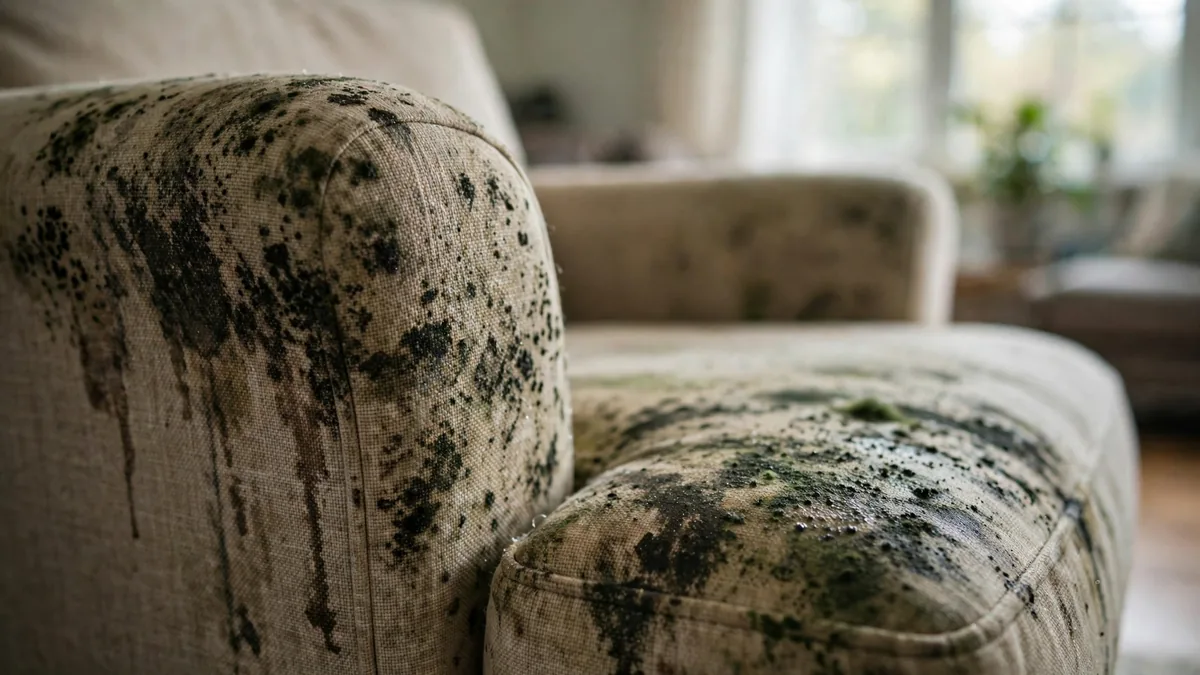
You pull a chair out from the wall and find the back covered in fuzzy spots. Or you lift a sofa cushion and the underside smells like a damp basement. Mold on furniture is unsettling because the question is never just about cleaning; it is about whether the piece is safe to keep at all.
The honest answer: some furniture can be saved, some cannot, and the deciding factors are the material, how deep the mold has grown, and whether the piece has sentimental or monetary value worth the effort. This guide gives you a clear save-or-toss framework for wood, upholstery, leather, and mattresses, plus cleaning methods that actually work and the mistakes that make things worse.
One rule before anything else: find the moisture source. Mold on furniture means the room is too damp, period. Clean the piece without fixing the humidity and the mold comes back. If the whole room smells musty, read our guide on tracking down hidden mold behind a musty smell before you spend a minute scrubbing.
The save-or-toss decision framework
Run every affected piece through these three questions before you decide. They will save you from both throwing away a salvageable heirloom and keeping a lost cause that keeps making the room smell.
1. What is it made of?
Non-porous materials like solid wood, metal, glass, and hard plastic can almost always be cleaned and saved, because mold grows on the surface rather than inside the material. Porous materials like upholstery fabric, foam cushions, particleboard, and mattresses absorb mold deep into their structure, and cleaning only reaches the surface. Semi-porous materials like leather and finished wood fall in between.
2. How deep and widespread is the growth?
Surface mildew on a wood table leg is a cleaning job. Mold that has penetrated through upholstery into the foam cushion, or colonized the inside of a particleboard bookcase, is a disposal job. As a practical rule: if you can see or smell mold inside the material, not just on it, the piece is done.
3. What is the piece worth to you?
Professional upholstery mold remediation is expensive, often $200 to $600 per piece, and it is not always successful. For a $150 used sofa, replacement wins. For a $3,000 sectional or a family heirloom, professional cleaning may be worth attempting. Be honest about the math before you start.
What can usually be saved
Solid wood furniture
Wood is the best-case scenario. Take the piece outside or into a well-ventilated garage, HEPA-vacuum all surfaces including crevices, then wipe with a damp cloth and a mild detergent or a commercial mold cleaner. For stubborn staining in the grain, light sanding followed by refinishing works. The EPA’s mold cleanup guidance recommends exactly this approach: physical removal first, then cleaning, with the area kept dry afterward. Our guide on Concrobium versus bleach explains which products actually kill mold on wood versus which ones just bleach the color out.
Leather furniture
Finished leather can often be saved if the mold is on the surface. Wipe with a soft cloth dampened with a mix of water and rubbing alcohol or a leather-safe mold cleaner, then condition the leather afterward because cleaning strips its oils. Unfinished or suede leather is far harder; deep growth in suede usually means disposal. Never soak leather, and dry it away from direct heat, which cracks it.
Metal, glass, and hard plastic
These are straightforward: HEPA-vacuum, then clean with detergent and water, then disinfect. Mold cannot penetrate them, so thorough surface cleaning fully resolves the problem. Check joints, screws, and hollow sections where moisture and spores collect out of sight.
What should usually be thrown away
Upholstered furniture with deep growth
A sofa or armchair with mold through the fabric and into the foam is not a cleaning project. Foam cushions are essentially mold condominiums: warm, dark, and full of tiny air pockets. Surface cleaning leaves the colony inside intact, and the piece will keep releasing spores and odor. If the growth is limited to a small surface patch on the fabric and the cushion underneath is clean and dry, professional upholstery cleaning may work, but be realistic about the odds.
Mattresses with any mold
Throw it out. You spend a third of your life with your face inches from a mattress, and mold inside one cannot be reliably removed. This is the one category where there is no debate worth having. If a mattress got wet enough to grow mold, the box spring and bedding that contacted it should go too.
Particleboard and MDF furniture
Pressed-wood furniture swells and crumbles when wet, and mold grows through the entire thickness. Once particleboard is both water-damaged and moldy, it has no structural or hygienic value left. Bag it and discard it.
How to clean salvageable furniture safely
Whether you are tackling a wood dresser or a leather chair, the process follows the same safe sequence. Mold cleanup done wrong spreads spores through the house, so method matters as much as effort.
- Isolate the piece. Move it outside if possible, or seal off the room with plastic sheeting and open a window. Do not drag a moldy sofa through the whole house to reach the door; wrap it in plastic first.
- Gear up. At minimum: an N95 respirator, goggles, and gloves. Moldy upholstery releases a cloud of spores when disturbed, and your lungs should not be the filter.
- HEPA-vacuum everything. Vacuum all surfaces, crevices, and the underside before any wet cleaning. This removes the bulk of loose spores so they do not go airborne during scrubbing. A regular vacuum without a HEPA filter just redistributes them.
- Clean, do not just disinfect. Physical removal comes first: detergent and water with thorough wiping or scrubbing. Disinfectants work on what is left after cleaning, not instead of it.
- Dry completely and fast. Put the piece in sunlight or in front of fans and a dehumidifier. Anything that stays damp for more than a day or two starts the cycle over.
For black mold specifically, which worries homeowners the most, our guide on how to remove black mold covers identification and safe handling, and the CDC’s mold and health information explains who is most sensitive to exposure during cleanup.
Stop it from spreading to the rest of the house
A moldy piece of furniture is a spore source for every other porous thing in the room. While you deal with it, run a HEPA air purifier nearby, keep the room’s humidity below 50 percent with a dehumidifier, and do not store clean fabrics, books, or papers in the same room until the moisture problem is solved.
Check the neighbors: mold on one piece of furniture often means mold on the wall behind it, the carpet under it, or inside the adjacent drywall. Pull the furniture away from walls, inspect with a flashlight, and sniff the wall cavity area. If the wall itself is affected, you are past furniture cleaning and into remediation territory; our overview of the mold remediation process explains what professional containment and removal involves.
The EPA notes that mold can begin growing on damp surfaces within 24 to 48 hours, which is why drying a wet chair or sofa immediately matters more than any cleaning product you apply later.
Frequently Asked Questions
Can mold be fully removed from upholstery?
Surface mold on upholstery fabric can be removed, but mold that has penetrated into foam cushions cannot be reliably eliminated. If the cushion underneath smells musty or shows staining, the piece should be discarded or professionally evaluated; surface cleaning alone will not solve it.
Is it safe to keep furniture that had mold after cleaning?
Yes, if the piece is non-porous or the mold was truly surface-only, it was cleaned thoroughly with HEPA vacuuming plus detergent cleaning, and the moisture source is fixed. If odor persists after proper cleaning, that is a sign mold remains inside the material, and the piece should go.
Does sunlight kill mold on furniture?
Sunlight helps: UV inhibits mold growth and thorough drying in sun is genuinely useful. But sunlight alone does not reliably kill an established colony or remove staining. Think of it as an excellent drying aid and a supplement to cleaning, not a treatment by itself.
Can I use bleach on moldy furniture?
Bleach is a poor choice for porous materials like wood and upholstery: it bleaches the color without killing mold roots in porous surfaces, and the water in bleach solutions can feed regrowth. On hard non-porous surfaces it works as a disinfectant after cleaning, but dedicated mold cleaners or detergent plus thorough drying are better for furniture.
How do I know if mold is inside my sofa cushions?
Unzip the cushion covers and look at the foam: yellow or brown staining, a musty smell that does not fade after airing out, or visible fuzzy growth all mean the foam is colonized. Foam cannot be effectively cleaned once mold is inside it.
Should I file an insurance claim for moldy furniture?
It depends on the cause. If the mold resulted from a covered sudden event like a burst pipe, contents coverage may apply minus your deductible. Mold from chronic humidity or neglected leaks is typically excluded. Document the cause and the damage before discarding anything you intend to claim.
The bottom line
Solid wood, leather, metal, and hard plastic furniture with surface mold can almost always be saved with HEPA vacuuming, thorough cleaning, and fast drying. Upholstery with mold in the foam, any moldy mattress, and swollen particleboard should be thrown away. The material and the depth of growth decide, not the cleaning product.
Your next moves, in order: isolate the piece, fix the room’s moisture problem first, then work through the save-or-toss framework piece by piece, starting with whatever is closest to an air vent or HVAC return.