

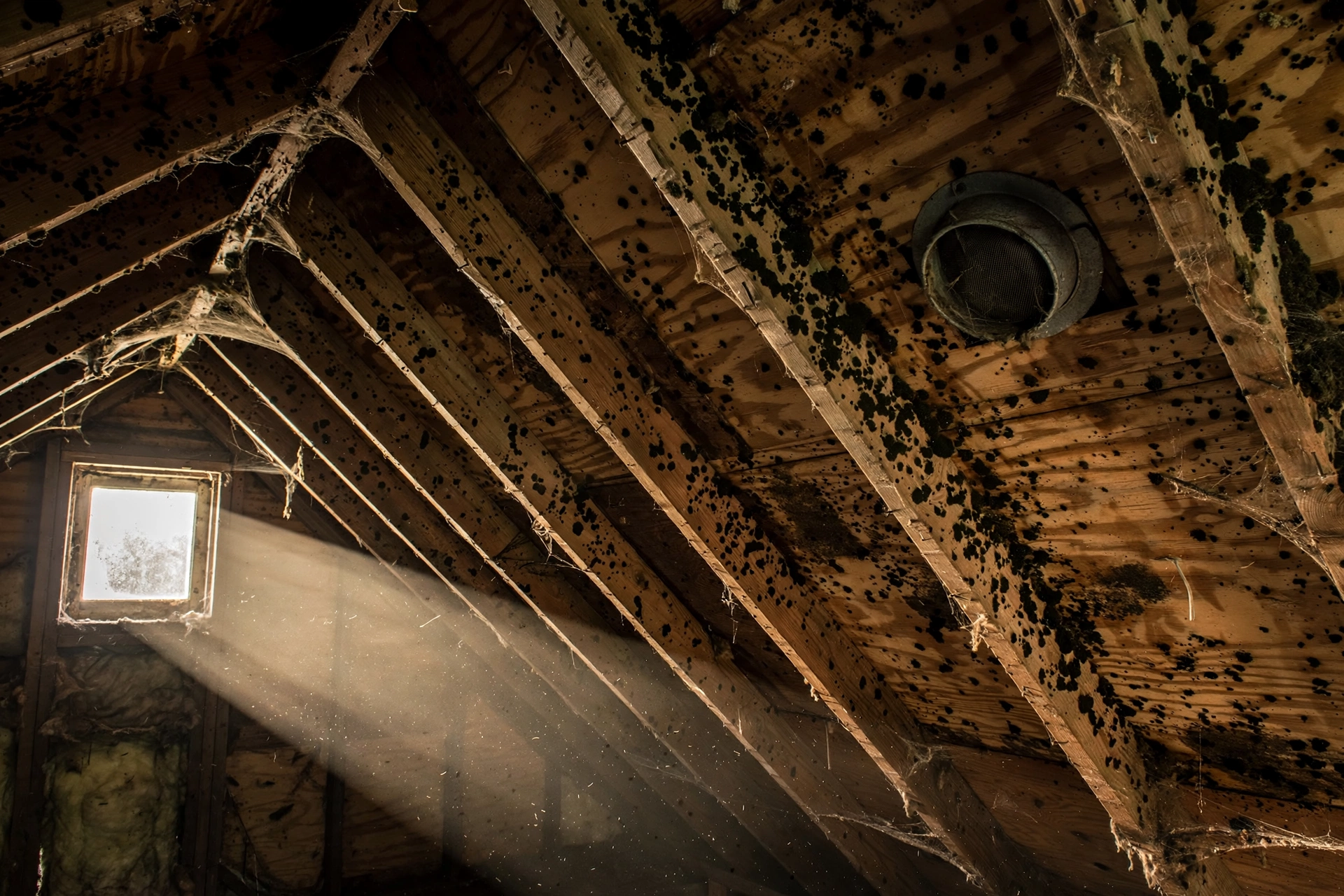
Most homeowners discover attic mold the same way: an inspector, a roofer, or a curious trip up the pull-down stairs reveals dark staining across the underside of the roof. It is unsettling, partly because the attic is the last place you look and partly because the staining can look extensive. The good news: attic mold is rarely a structural emergency, and its cause is usually straightforward once you know where to look.
The surprise for most people: attic mold is usually not caused by a roof leak. It comes from warm, moist indoor air condensing on the cold underside of the roof deck. Fix the airflow problem and the mold loses its water supply. This guide explains why attics grow mold, how pros remediate it, what it costs, and how to keep it from coming back.
Why attics grow mold: the condensation cycle
An attic should stay close to outdoor temperature in winter. When warm living-space air leaks up, it carries moisture that condenses on the coldest surface: the underside of the roof sheathing. Plywood decking is organic, so once it stays damp, mold moves in.
The moisture comes from inside the house. The usual suspects:
- Bathroom exhaust fans venting into the attic. This is the number one cause: every shower pumps moisture into the air, and a fan dumping it into the attic humidifies the space daily.
- Kitchen range hoods and dryer vents terminating in the attic. Same problem, larger volumes. Dryer exhaust is especially bad: hot, wet, and linty.
- Air leaks from the living space. Recessed lights, attic hatches, plumbing chases, and gaps around chimneys let warm air stream upward all winter. Each leak is small; together they move a lot of moisture.
- Inadequate ventilation. An attic needs balanced intake (soffit vents) and exhaust (ridge vent or similar) so air flows through and carries moisture out. Blocked soffits, from insulation shoved into the eaves, are extremely common.
Roof leaks cause mold too, but the pattern differs: leak-driven mold clusters around the entry point with visible water staining, while condensation-driven mold spreads broadly across the sheathing, often worst on the north-facing slope. Knowing which pattern you see points at the right fix.
What attic mold looks like (and what it is not)
Attic mold usually appears as dark gray, black, or brown staining on plywood or OSB sheathing, sometimes in large patches. It looks alarming, but surface staining is usually just that: growth on the wood surface, not rot. True rot makes sheathing soft and crumbly; staining alone does not weaken the wood significantly.
A few things get mistaken for mold. Rust-colored staining around nail heads is just rust. Dark streaks from long-dried leaks may be old staining with no active growth. Natural plywood color variation can look suspicious too. If unsure, check whether the wood is damp with a moisture meter and whether the staining wipes onto a cloth. Active mold on damp wood needs remediation; dry old staining may just need monitoring.
How professionals remediate attic mold
Attic remediation follows the same principles as mold work elsewhere, adapted for the space:
- Inspection and moisture mapping. The contractor identifies the moisture source (fans, leaks, air bypasses) and maps affected sheathing. Fixing the source is planned as part of the job, not an afterthought.
- Containment and protection. The attic access is sealed from living spaces and the HVAC system is protected. Workers wear full PPE: respirators, suits, gloves, eye protection.
- HEPA vacuuming. Affected surfaces are vacuumed with HEPA-filtered equipment to capture loose spores and growth.
- Cleaning the sheathing. Depending on severity: wire brushing and wiping, sanding, or media blasting (dry ice or soda blasting) for widespread staining. The goal is removing growth, not every stain. Some staining remains after the mold is gone.
- Antimicrobial treatment. A professional-grade antimicrobial is applied to cleaned surfaces as a finishing step.
- Source fixes. Bathroom fans get ducted outside, air leaks get sealed, ventilation gets corrected. This step determines whether the job lasts.
- Verification. Moisture readings confirm the space is dry; a visual inspection confirms the growth is gone.
One thing pros generally do not do: spray bleach across the attic and leave. Bleach is a poor choice on porous wood, and spraying without fixing ventilation guarantees a callback. If a contractor’s whole plan is a spray treatment with no mention of fans, air sealing, or ventilation, get a second quote.
What attic mold remediation costs
Realistic U.S. ranges: a small, localized job (one slope section, straightforward fan rerouting) often runs $1,000 to $2,500. A full attic remediation with media blasting, multiple fan reroutes, and air sealing commonly lands between $3,000 and $7,000. Large or complex attics with access issues can exceed $10,000.
Price drivers: square footage of affected sheathing, whether the crew can stand or must crawl, how many fans need rerouting, and whether insulation must be removed and replaced. Catching it early, easy access, and bundling ventilation fixes with remediation instead of two separate visits keep costs down. These are estimates, not quotes: get at least two local assessments.
Can you DIY attic mold cleanup?
Honestly, attics are among the worst DIY mold environments: cramped, hot, poorly lit, full of trip hazards, and miserable in a respirator and suit overhead. Disturbing a large colony without containment can push spores into living spaces through every ceiling penetration.
Small, accessible patches (a few square feet near the hatch, with an obvious fixed source like a since-rerouted fan) can be handled by a careful homeowner following EPA cleanup guidance and CDC safety precautions, with a real respirator rather than a dust mask. Anything widespread, anything large and overhead, or any job where you cannot find the moisture source belongs to a professional. Our black mold removal guide covers the safety fundamentals.
Prevention: the ventilation and air-sealing checklist
Remediation without prevention is temporary. The permanent fix addresses every item here:
- Duct every exhaust fan to the exterior. Bathroom fans, kitchen hoods, and dryers must terminate outside through the roof or a gable wall, never into the attic or soffit. This one fix resolves a large share of cases.
- Seal attic air leaks. Weatherstrip the hatch, seal recessed lights with approved covers, and close plumbing and wiring chases with caulk or foam. Air sealing matters more than most people expect.
- Balance the ventilation. Keep soffit intake vents clear of insulation (use baffles), paired with ridge or gable exhaust. The general rule is about 1 square foot of net free vent area per 150 square feet of attic floor, split between intake and exhaust.
- Keep indoor humidity reasonable. Whole-house humidity in the 30 to 50 percent range, the EPA’s recommended band, means less moisture migrating upward.
- Check annually. A five-minute attic peek each fall with a flashlight catches recurrence years before it becomes a project.
Note the contrast with mold on basement walls, usually a drainage and dehumidification problem. Attic mold is an airflow problem. Different zone, different physics, different fix.
Attic mold and your home sale
Many people discover attic mold through an inspection report, and it can spook buyers, but it rarely kills a deal when handled properly. Get professional remediation with documentation, fix the ventilation causes, and keep the paperwork. A documented fix reads as responsible maintenance; an untreated attic with a vague promise reads as risk. If you are buying and the inspection finds it, ask the seller for remediation by a qualified contractor, not a spray-and-pray treatment.
If the staining appeared after a bathroom renovation, check the fan first. New fans vented into the attic by a careless installer are a depressingly common origin story, and the fix is a few hours of ductwork.
Frequently Asked Questions
Is mold in the attic dangerous?
It rarely affects indoor air quality directly, since stack effect usually pushes attic air up and out rather than down into living spaces. The bigger risks are long-term roof structure damage and home value. Large colonies should still be remediated, not ignored.
Will the mold come back after remediation?
Only if the moisture source remains. Properly remediated attics with corrected ventilation and sealed air leaks stay clean. Recurrence within a year or two almost always means a fan still vents into the space or a leak was missed.
Can mold in the attic spread to the rest of the house?
Spores can travel through ceiling penetrations, recessed lights, and an unsealed hatch, especially during remediation without containment. That is why professional containment matters, and why DIYers should seal the hatch area with plastic before working.
Does homeowners insurance cover attic mold remediation?
Sometimes, if it came from a covered sudden event like storm roof damage. Mold from long-term condensation or maintenance issues is typically excluded. Check your policy language on mold and gradual damage.
How long does professional attic remediation take?
Most residential jobs take one to three days of active work, plus scheduling and any insulation replacement. Ventilation corrections are often done in the same visit.
Bottom line
Attic mold looks scary but follows simple logic: moist indoor air reaches cold roof sheathing because a bathroom fan vents into the attic, air leaks bypass the ceiling, or ventilation is out of balance. Pros clean the sheathing, but the lasting fix is ducting fans outside, sealing air leaks, and balancing ventilation. Handle a small patch yourself only if it is truly minor and the source is fixed; hire out anything widespread or overhead. And remember: once wood stays damp, mold can establish within days, so a fan venting into the attic all winter has had plenty of time. Fix the airflow, and review our mold cleanup safety guide and bathroom mold removal guide before anyone picks up a scrub brush.