

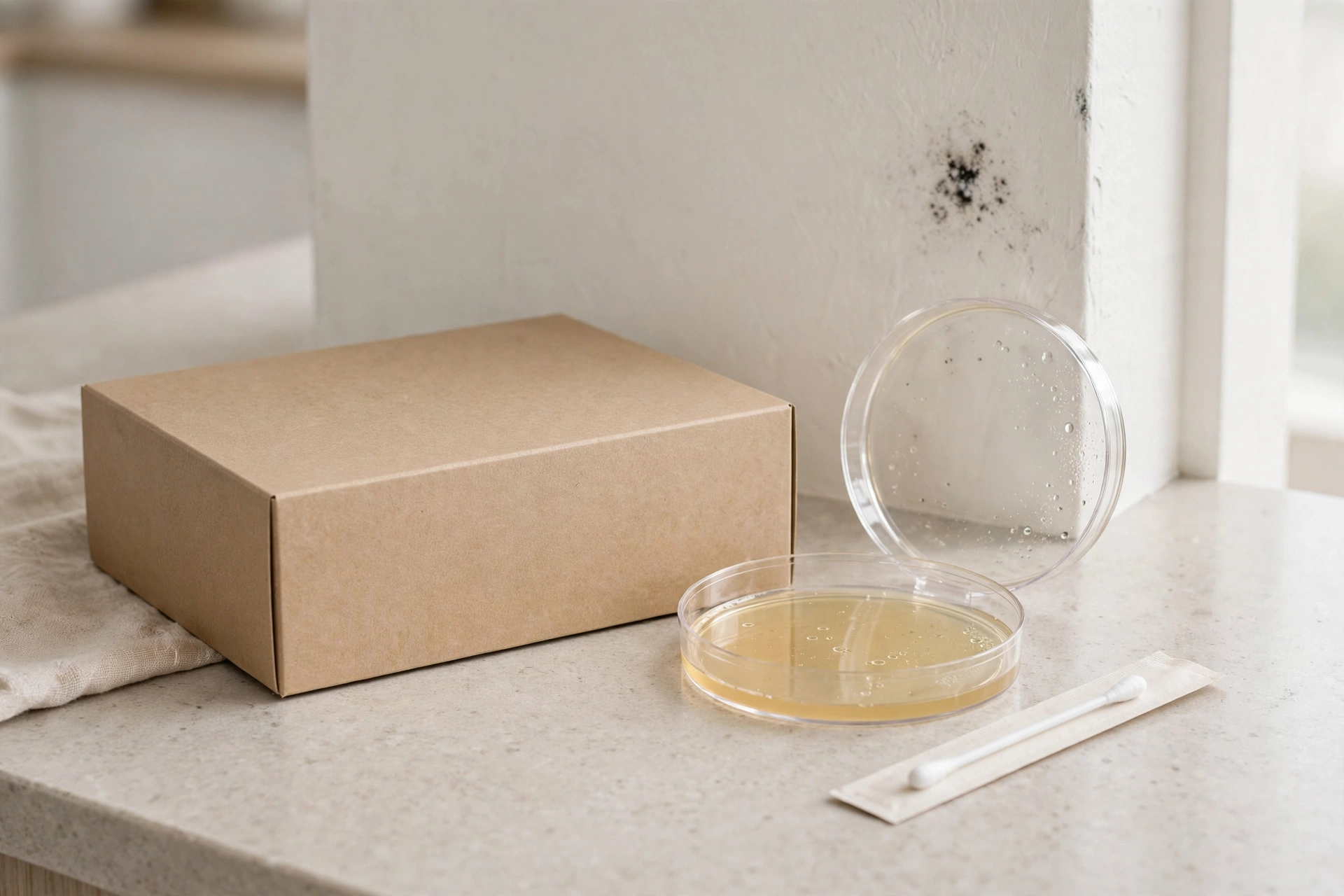
Home mold test kits sit on store shelves promising laboratory answers for around $30. Swab a surface, leave a petri dish open for an hour, mail it to a lab, and wait for results. It sounds like a smart first step before paying for a professional inspection, and for homeowners who just want to know what they are dealing with, the pitch is convincing.
The problem is that these kits answer the wrong question. They can tell you that mold spores exist in the air, which they do in every home, but they cannot tell you whether you have a mold problem. Understanding the difference saves you money and points you toward tests that actually help.
This guide explains how the common kit types work, where their results mislead people, and what to do instead depending on your situation.
The three types of home mold test kits
Most kits fall into three categories. Settling plate or petri dish kits are the most common: you open a dish of growth medium in a room for about an hour, seal it, wait several days, and look for colonies. Swab kits let you sample a visible growth and mail the swab to a lab for identification. A smaller group of kits pump a small volume of air through a cassette that you send to a lab for spore counts.
Lab analysis versions cost more because you pay the lab fee on top of the kit, sometimes another $30 to $50 per sample. Some kits include one free analysis and charge for extras. Read the fine print before buying; the sticker price often understates the total cost.
What the results actually mean
Here is the core limitation: a petri dish left open in a room will grow mold in nearly every home. Mold spores are a normal component of indoor and outdoor air. Getting colonies on a plate tells you that mold exists, which you already knew. It does not tell you the concentration, where it came from, or whether levels are elevated compared to the air outside your home.
Professional inspectors always take an outdoor control sample, because indoor spore levels are only meaningful next to an outdoor baseline. A kit that tests one room with no comparison gives you a number with nothing to compare it to. This is the single biggest gap between DIY kits and professional testing.
The EPA advises that sampling for mold is usually unnecessary if visible mold is present, because resources are better spent on fixing the moisture and cleaning up the growth, according to the agency’s mold guidance.
How kits mislead people in both directions
False alarms are the most common problem. A scary-looking dish sends a homeowner into a panic over normal background spores, leading to expensive remediation for a problem that may not exist. The reverse happens too: a clean dish convinces someone their home is fine while hidden mold grows inside a wall cavity the dish could never detect.
Swab kits have their own trap. Identifying the exact species of a visible growth is rarely useful information for a homeowner. Whether the colony is Cladosporium or something with a scarier name, the cleanup approach is the same: fix the moisture, remove the mold. Knowing the species changes almost nothing about what you do next, and it costs you weeks of waiting.
Timing creates another distortion. One petri dish captures one hour in one spot. Mold levels fluctuate with humidity, seasons, HVAC cycles, and even whether someone recently dusted. A single snapshot is a poor basis for decisions, especially expensive ones.
Lab-analyzed kits add cost and waiting time on top of these weaknesses. Between the kit, the per-sample lab fees, and shipping, a three-sample kit can run $100 or more, and results take one to two weeks. That is real money and real delay spent on data that still cannot tell you whether you have a problem worth acting on. For that same budget, a moisture meter and a thorough visual inspection of the usual hiding places deliver far more useful information.
The one situation where a kit is not useless
There is a narrow legitimate use. If you had professional remediation done and want a rough peace-of-mind check afterward, a settling plate in the treated room can be a cheap reassurance. It still lacks an outdoor control, so interpret modest growth calmly. But as a low-cost confirmation that the room looks like a normal room, it is harmless.
Kits also occasionally help renters document a suspected problem. A visible colony growing from an air sample can photograph well in a landlord dispute. It is not scientific proof, but combined with photos of visible growth or a musty odor, it can strengthen a request for repairs. Just know its evidentiary limits.
What to do instead
If you can see mold, skip the testing entirely and go straight to cleanup and moisture control. Testing a visible colony adds cost and delay without changing the plan. The money goes further toward fixing the leak and removing the growth.
If you cannot see mold but smell that musty odor or have symptoms that improve when you leave the house, your problem is investigation, not a test kit. Check the usual hiding places: behind washing machines, under sinks, around toilet bases, inside mold in air ducts, and in basements and crawl spaces. Our guide to hidden mold behind musty smells walks through where to look and when to open up a wall.
When you genuinely need numbers, hire a professional inspector who takes indoor and outdoor air samples with calibrated equipment and sends them to an accredited lab. Expect $300 to $800 depending on your market and the number of samples. That price buys what a $30 kit cannot: calibrated volume collection, outdoor baselines, and someone who knows where to sample.
Health questions the kits raise
Many buyers reach for a test kit because someone in the house is coughing, wheezing, or dealing with allergies. The CDC notes that mold exposure can cause nasal stuffiness, eye irritation, and wheezing, and that people with mold allergies or asthma can have severe reactions. If you are dealing with black mold health effects or wondering about mold and asthma, the useful step is medical evaluation plus moisture control, not a petri dish. A kit cannot diagnose whether mold is causing symptoms, and waiting for lab results while mold keeps growing is the worst of both worlds.
Frequently Asked Questions
Are home mold test kits accurate?
They accurately detect the presence of mold spores, which are present in essentially all homes. What they do not do accurately is diagnose a mold problem, because they lack outdoor control samples and calibrated air volume measurements. For identifying a problem worth acting on, they are unreliable.
Which type of mold test kit is best?
Lab-analyzed air cassettes are the most useful of the DIY options, since they give spore counts rather than just a yes-or-no dish. Even these fall short of professional sampling, which uses calibrated pumps and always includes an outdoor control. If you buy any kit, get one with lab analysis, not a self-read dish.
Can a mold test kit tell me if mold is making me sick?
No. No home kit can establish a link between mold and symptoms. If you have respiratory symptoms that seem tied to your home, see a healthcare provider and focus on reducing indoor moisture and removing any visible mold. Testing identifies spores; it does not diagnose health conditions.
Do I need to test before removing mold?
No, and the EPA says testing is usually unnecessary when mold is visible. Testing before cleanup adds cost and delay without changing the plan: find the moisture source, remove the mold, dry everything. Testing is mainly useful for post-remediation verification and for investigating hidden mold in specific cases.
What does professional mold testing cost?
A typical professional inspection with lab-analyzed air samples runs $300 to $800 in most U.S. markets, depending on the number of samples and whether surface samples are included. Compare that against a $30 kit: you are paying for calibrated equipment, an outdoor baseline, a trained sampler, and a written interpretation of results.
The bottom line
Home mold test kits are not scams in the strict sense, but they solve a problem you do not have: proving that mold spores exist. You already know they exist. If you see mold, skip the kit and clean it up. If you suspect hidden mold, investigate the moisture. And if you need real numbers, hire a professional whose equipment and method can actually produce them.