

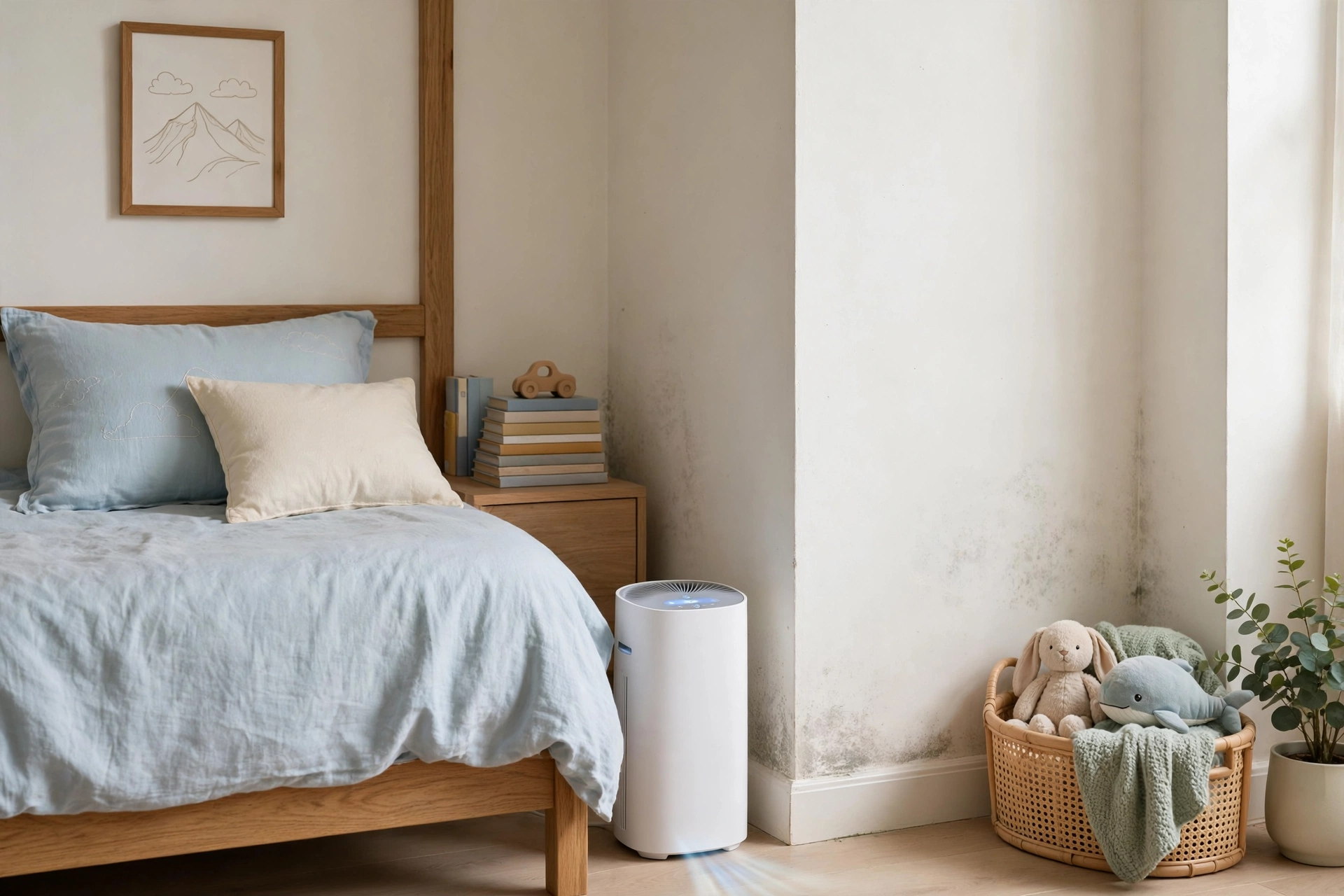
If someone in your home has asthma, mold is not just a housekeeping problem. It is one of the indoor triggers most likely to set off attacks, send a child to urgent care, or quietly make a well-controlled condition worse over months. And unlike pollen season, indoor mold does not end in October.
The link between mold and asthma is one of the better-established facts in indoor air quality science. Researchers have studied it for decades, and the findings are consistent enough that health agencies state them plainly. This guide explains what mold does to asthmatic airways, who in the family faces the most risk, and the practical steps that actually reduce exposure.
How mold triggers asthma
Asthma is an inflammatory condition of the airways. In people with allergic asthma, the immune system overreacts to inhaled particles, and mold spores are among the classic triggers, alongside dust mites, pet dander, and pollen. When spores hit sensitized airways, the airways swell, produce extra mucus, and tighten, which is an asthma attack.
Even people with non-allergic asthma can react. High concentrations of spores irritate airways directly, no allergy required, and the damp conditions that grow mold also grow dust mites and bacteria that compound the problem. A damp home assaults asthmatic lungs from several directions at once.
The CDC notes that exposure to damp and moldy environments may cause or worsen asthma symptoms, and that people with asthma should take particular care to avoid mold exposure. This is not a debated claim; it sits in the well-supported column. For the full symptom picture, see our overview of mold exposure symptoms.
What the research shows
The Institute of Medicine’s 2004 review found sufficient evidence that indoor mold exposure is associated with asthma symptoms in people who already have asthma, and with the development of asthma in some populations. Later research has largely reinforced this: damp homes and mold exposure track with more frequent symptoms, more medication use, and more emergency visits.
Studies of children are especially consistent. Kids in homes with visible mold or dampness have higher rates of wheeze, persistent cough, and asthma exacerbations. The effect shows up across countries and climates, which strengthens the case that it is the dampness and mold doing it, not some local confounder.
One important nuance: mold usually worsens existing asthma rather than creating asthma from nothing in adults. But in children, the evidence suggests damp indoor environments can contribute to asthma development, which raises the stakes for families with young kids in moldy homes.
Who in the family faces the most risk
Children with asthma
Kids are the highest-priority group. Their airways are smaller, so the same amount of inflammation causes more obstruction. They breathe more air per pound of body weight than adults, spend more time on floors where spores settle, and cannot always articulate that the basement playroom makes them wheeze. If your child’s asthma action plan keeps getting used at home but rarely at school, the house deserves investigation.
Adults with severe or brittle asthma
People whose asthma is hard to control have the least margin for extra triggers. For them, a moldy bedroom can be the difference between a stable month and a hospitalization. If control has slipped without an obvious reason, an indoor trigger assessment is worth discussing with the doctor.
Older adults
Aging lungs and immune systems handle chronic airway irritation poorly, and older adults may attribute worsening breathlessness to aging rather than to the environment. A musty spare bedroom that became a full-time bedroom after retirement is a scenario worth checking.
Everyone else in a damp home
Family members without asthma are not off the hook. Chronic exposure can sensitize people over time, and the EPA’s indoor air quality guidance emphasizes keeping indoor humidity in the 30 to 50 percent range partly because dampness affects everyone’s airways. Our article on black mold health effects covers the broader household risks.
Signs mold is affecting someone’s asthma
Watch for these patterns, and bring them to the doctor rather than trying to manage around them indefinitely.
- Needing a rescue inhaler more often at home than elsewhere
- Nighttime coughing or wheezing that started or worsened after water damage
- Asthma that was well controlled and is not anymore, with no change in medication
- Symptoms that ease during trips away and return within a day or two of coming home
- Frequent respiratory infections on top of the asthma
- A musty-smelling bedroom paired with morning symptoms
The home-away pattern is the single most useful observation you can make. Doctors cannot test your house, but they can act on a clear pattern you report.
Reducing mold exposure for asthmatic family members
Fix moisture first, always
No air purifier compensates for an active leak. Find and fix the water source, whether it is a plumbing leak, roof issue, grading problem, or condensation. Then dry everything thoroughly. Our guide to preventing mold after water damage walks through the sequence that actually works.
Remove the mold, do not just kill it
Dead spores can still trigger allergies, so the goal is physical removal, not just spraying something on it. Small surface patches can be scrubbed with detergent and water. Porous materials that stayed wet, like drywall, carpet, and insulation, usually need to come out. The EPA’s cleanup guidance draws the line around 10 square feet: bigger than that, consider professional help.
Control humidity continuously
Keep indoor relative humidity between 30 and 50 percent. A hygrometer costs under $15 and tells you the truth about your home. Run a properly sized dehumidifier in damp basements, vent bathrooms and kitchens to the outside, and fix condensation on windows and pipes. Humidity control is the long game that keeps mold from returning.
Do not forget the HVAC system
Ducts and air handlers can harbor mold and then distribute spores to every room with each cycle. If there is a musty smell when the system runs, or visible growth on vents, the ducts need attention. Our guide to mold in air ducts covers symptoms, testing, and what cleaning should cost.
Clean smart during remediation
Remediation stirs up spores, which temporarily makes air quality worse. Keep asthmatic family members out of the work area and ideally out of the house during heavy work. Run HEPA air filtration, seal off the work zone with plastic sheeting, and change HVAC filters after the job.
Working with your doctor
Bring the environmental angle to the appointment explicitly. Doctors treat the patients in front of them and may not ask about your basement unless you raise it. Useful things to bring: a symptom diary with dates and locations, notes on the home-away pattern, photos of any visible mold or water damage, and your current asthma action plan.
Ask whether allergy testing for molds makes sense, whether the action plan needs adjusting while remediation is underway, and what threshold should send you to urgent care. If a child is involved, loop in the school nurse too; symptoms at school point to a different trigger than symptoms only at home.
Health note: This article is for general information only and is not medical advice. If you have symptoms you think may be related to mold exposure, talk to a qualified healthcare provider.
Frequently Asked Questions
Can mold cause asthma in someone who never had it?
In adults, mold more commonly worsens existing asthma than creates new cases. In children, studies suggest that growing up in damp, moldy homes can contribute to developing asthma. Either way, reducing exposure is the right move.
How much mold does it take to trigger an asthma attack?
There is no universal threshold; sensitivity varies enormously between people. Some react to levels others would never notice. Rather than chasing a number, focus on visible growth, musty odors, and symptom patterns, and on getting humidity under control.
Will an air purifier protect my asthmatic child from mold?
A true HEPA purifier reduces airborne spores in the room it serves, which can help as a supplement. It does not fix the source, does not reach mold inside walls, and does nothing about humidity. Think of it as a bandage: useful while you arrange the actual fix, not a substitute for it.
Should we move out during mold remediation?
For major remediation, especially with an asthmatic child in the home, temporary relocation is often the safest choice. Spore counts spike during demolition and cleaning. At minimum, keep sensitive family members completely out of the work zone with the HVAC isolated from it.
Can mold allergy testing tell us if mold is the problem?
Allergy testing can confirm sensitivity to specific molds, which is useful information. But a positive test does not prove your home’s mold is causing the symptoms, and a negative test does not rule out irritant effects. Combine test results with the symptom pattern and a home inspection.
How long after remediation should asthma improve?
Many people notice improvement within days to weeks of proper remediation and moisture control. If symptoms do not improve after a thorough job, revisit the diagnosis with the doctor; something else may be driving the asthma, or mold may remain hidden somewhere.
The bottom line
The mold and asthma connection is real, well studied, and most dangerous for children and people with hard-to-control asthma. Spores trigger attacks, dampness worsens control, and the fix is environmental as much as medical.
Fix the moisture, remove the mold properly, keep humidity in the 30 to 50 percent range, and bring the home-away symptom pattern to your doctor. Asthma you can control at the doctor’s office but not in your own bedroom is telling you something. Listen to it.