

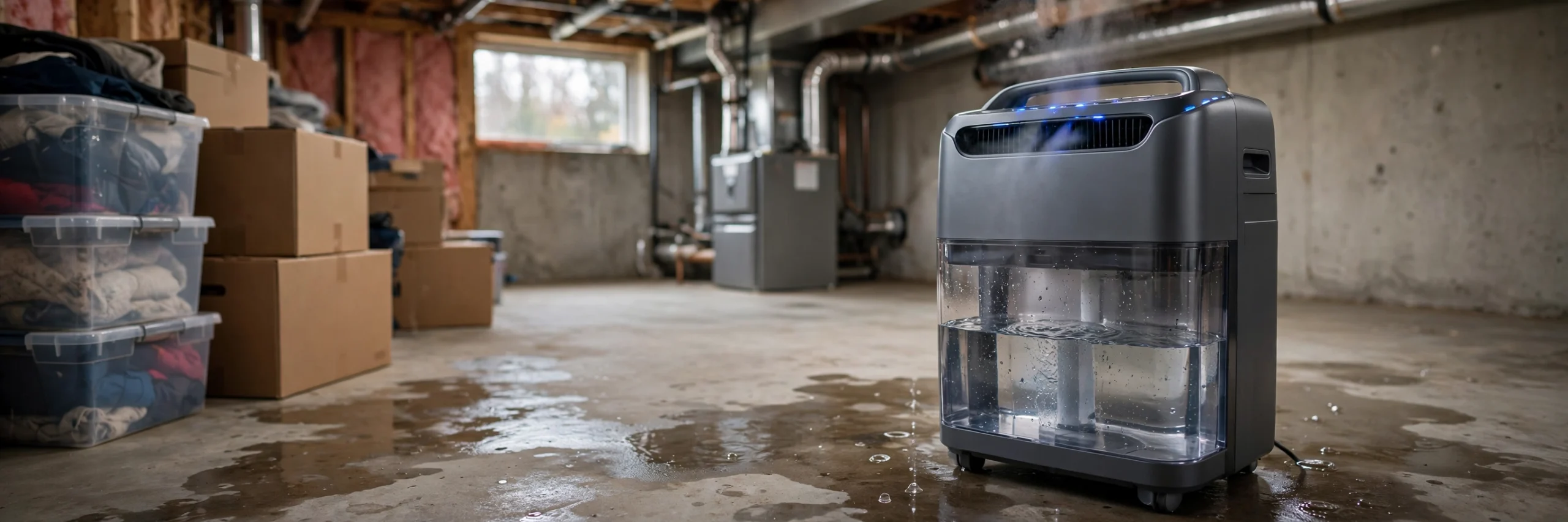
Walk into any big-box store and you will find twenty dehumidifiers that all claim to fix your damp basement. Half of them are undersized for real basement conditions, and the other half have features you will never use. Buying the wrong one means a unit that runs around the clock, never quite gets humidity under control, and dies in two years.
This 2026 buying guide cuts through the noise. You will learn how to size a dehumidifier by pints per day, which features are actually worth paying for, how portable, whole-house, and crawlspace units compare, and how to set yours up so it works with minimal babysitting.
How dehumidifier sizing actually works
Dehumidifiers are rated in pints of water removed per day under standard test conditions. The number that matters is not the marketing number on the box, it is the capacity matched to your space and dampness level. Here is a practical sizing starting point for basements:
- Slightly damp, musty in summer only: 30-pint unit per 1,000 sq ft.
- Noticeably damp, condensation on walls or pipes: 40 to 50 pints per 1,000 sq ft.
- Wet, musty odor year-round, or post-flood drying: 50 to 70 pints per 1,000 sq ft, possibly two units for large or divided spaces.
- Crawlspaces: dedicated low-profile crawlspace units, typically 55 to 90 pints, designed for low clearance and ducting.
Two sizing traps to avoid. First, test conditions changed: since 2019 the DOE tests at lower temperature and humidity, so a “50-pint” 2026 unit extracts less in absolute terms than a pre-2019 “50-pint” unit did. Compare current ratings to current ratings only. Second, basements run cooler than living spaces, and refrigerant dehumidifiers lose efficiency below about 65°F. If your basement sits in the 50s and 60s, prioritize a unit with good low-temperature performance or auto-defrost.
When in doubt, size up rather than down. An oversized unit cycles off when the job is done; an undersized one runs forever, uses more electricity over time, and still leaves you above 60 percent humidity. Our basement mold prevention guide explains the humidity targets you are sizing for.
Features worth paying for (and ones to skip)
Worth it
- Built-in humidistat with a numeric setpoint: set it to 45 percent and let the unit cycle itself. Units with only “low/medium/high” dials force guesswork.
- Continuous drain option: a gravity drain outlet or built-in pump. Emptying a bucket twice a day gets old by day three, and a full bucket shuts the unit off exactly when you need it running.
- Auto-defrost: essential for basements under 65°F. Without it, coils ice up and the unit stops dehumidifying while still drawing power.
- Washable filter: cheap to maintain, and a clogged filter is the number one cause of declining performance.
- Auto-restart after power outages: storms cause both outages and the humidity spikes you bought the unit for.
Usually not worth extra money
- Wi-Fi and app control: fun for a week, then you never open the app. A humidistat does the real work.
- Air purifier add-ons: a dehumidifier is not an air purifier, and combo filters are expensive to replace.
- Ultra-quiet marketing claims: all compressor dehumidifiers make noise. Place it away from living areas instead of paying a premium for a few decibels.
The three types compared
Portable refrigerant dehumidifiers
The standard choice for most basements: 30 to 70 pint capacity, rolls on casters, plugs into a normal outlet. Best for spaces up to about 1,500 sq ft with moderate dampness. Expect to pay $200 to $400 for a quality unit in 2026. Lifespan is typically 3 to 5 years of heavy basement use; budget accordingly rather than expecting a decade.
Crawlspace and commercial-grade units
Low-profile, ductable, often with built-in pumps and remote humidistats. Made for harsh, cool, tight spaces where portables struggle. They cost $800 to $1,500 but last longer and perform far better below 60°F. If your “basement” is really a damp crawlspace, this is the right category, not a bigger portable.
Whole-house dehumidifiers
Tied into your HVAC ductwork to treat the entire home, typically 90 to 130 pints per day. Best when humidity is a whole-house problem, not just the basement, or when you want set-and-forget operation with no buckets and no floor unit. Installed cost runs $1,500 to $3,000. Overkill for a single damp basement, ideal for humid climates where the whole house hovers near 60 percent.
Energy use: what it really costs to run
A 50-pint Energy Star unit draws roughly 500 to 700 watts while the compressor runs. In a damp basement cycling half the day, that works out to about $30 to $60 per month in electricity at average U.S. rates. Three ways to keep that number down:
- Choose an Energy Star certified model; the efficiency gap versus non-certified units is real.
- Fix the moisture sources first. Every gallon the unit does not have to remove is money saved. Seal the sump pit, extend downspouts, and fix grading before blaming the electric bill.
- Do not oversize wildly. A 70-pint unit in a slightly damp 600 sq ft basement short-cycles and wastes energy.
The EPA’s indoor air quality resources frame dehumidification as part of whole-home moisture control, which is the right way to think about operating cost: the dehumidifier is one piece of a system.
Setup tips most people miss
- Placement: center of the space, at least 6 to 12 inches from walls, away from the driest corner. Do not tuck it in a closet and expect it to treat the room.
- Drainage: run the hose to a floor drain, laundry sink, or sump pit with a continuous downhill slope. If no drain is nearby, a condensate pump ($50 to $80) lifts water to the nearest sink.
- Airflow: keep interior basement doors open so treated air circulates. A closed-off utility room stays damp while the main area reads fine.
- Initial pull-down: after a flood or in a very damp basement, expect the first week to fill buckets or run the drain constantly. That is normal; it is years of absorbed moisture leaving concrete and framing. If you are drying out after an actual water event, follow our post-water-damage drying checklist alongside the dehumidifier.
- Maintenance: rinse the filter monthly during heavy use, wipe the coils yearly, and check the drain hose for algae clogs each season.
When a dehumidifier is not enough
A dehumidifier manages humidity; it does not waterproof anything. Call in bigger solutions when:
- Water actively enters during rain. That is a drainage or waterproofing problem. See our breakdown of basement waterproofing costs to understand interior versus exterior options.
- Humidity stays above 60 percent with a correctly sized unit running constantly.
- You see efflorescence spreading, paint bubbling off walls, or wood rot on framing.
- The musty smell persists despite weeks of proper dehumidification, which suggests hidden mold.
The CDC’s mold prevention guidance makes the same distinction: dry the air, but fix the water.
Frequently Asked Questions
What size dehumidifier do I need for a 1,000 sq ft basement?
For moderate dampness, a 40 to 50 pint unit. For a very damp or musty basement, go 50 to 70 pints. Measure your humidity with a hygrometer first; the reading tells you which category you are in.
Should I get a dehumidifier with a pump?
If there is no floor drain or sink near where the unit will sit, yes. A built-in pump adds $50 to $100 but lets the hose run uphill to a distant drain, which means truly continuous operation.
How long do basement dehumidifiers last?
Portable units typically last 3 to 5 years in continuous basement duty. Commercial and crawlspace-grade units often last 7 to 10 years. Harsh conditions (dust, cold, constant running) shorten lifespan.
Can I use one dehumidifier for the basement and upstairs?
Not effectively. Humidity problems are local, and a portable unit only treats the air around it. If the whole house is humid, consider a whole-house unit tied to your HVAC instead.
Is it normal for a new dehumidifier to fill up constantly at first?
Yes. In a damp basement, the first week pulls years of stored moisture out of concrete and wood. It should taper off. If it never tapers, the moisture source is ongoing.
Do I need to run it year-round?
Usually not. Most basements only need dehumidification from late spring through early fall. Use a hygrometer and run the unit whenever readings climb past 55 to 60 percent.
What to do next
Measure your basement humidity for a week, then buy one size up from what the dampness suggests and plumb the drain so you never touch a bucket. Pair it with the drainage fixes in our basement mold prevention guide, and check the EPA’s mold and moisture guide for the principles behind every recommendation here. The best dehumidifier is the one that is correctly sized, continuously drained, and part of a real moisture plan.