

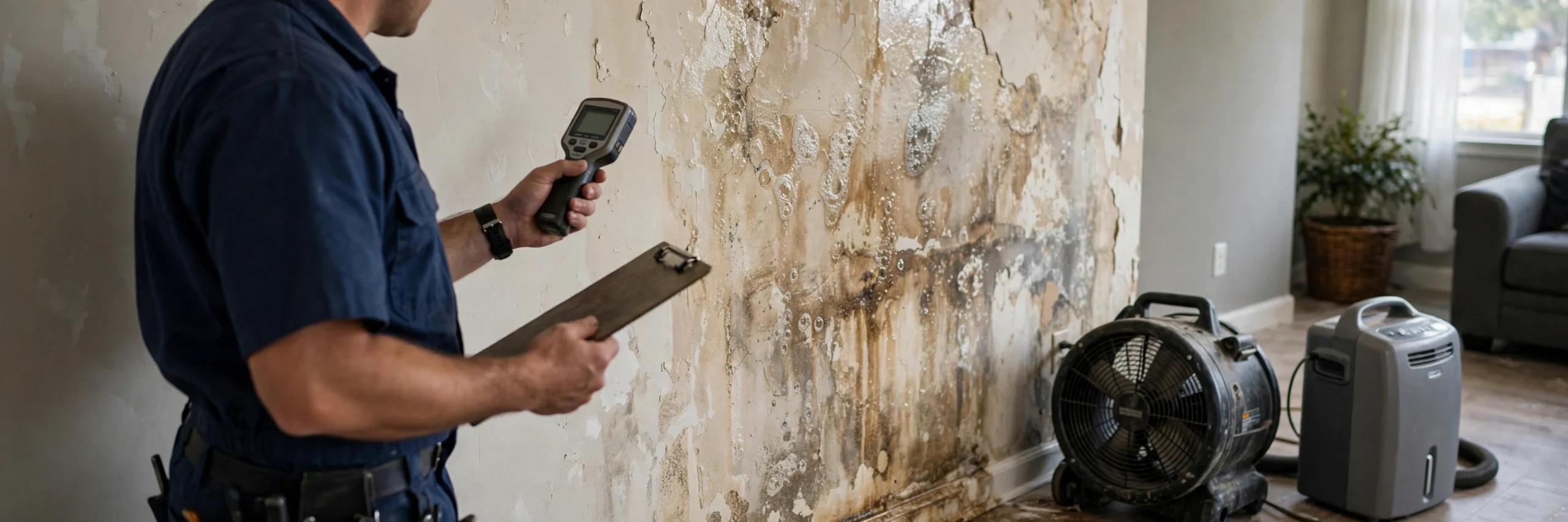
When water is pouring through your ceiling, you do not have time to become an expert on the restoration industry. But there is one credential worth knowing before you hire anyone: IICRC certification. Companies mention it on every truck and website, yet few homeowners know what it actually means or how to check it.
This guide explains what the IICRC is, which certifications matter for water damage and mold work, what certification does and does not guarantee, and how to verify a company’s claims in about five minutes.
What the IICRC actually is
The IICRC (Institute of Inspection, Cleaning and Restoration Certification) is a nonprofit organization that sets standards and certifies technicians in the inspection, cleaning, and restoration industries. It was founded in 1972 and operates internationally. Think of it less like a government licensing board and more like a professional standards body: it writes the rulebooks and tests whether technicians know them.
Two things the IICRC is not: it is not a government agency, and “IICRC certified company” is not the same as a licensed contractor. Licensing is handled at the state level and covers the legal right to do business; IICRC certification covers whether the technicians were trained to industry standards. You want both, and we will get to how they fit together below.
The IICRC’s standards carry extra weight because they are developed through the ANSI consensus process, the same system behind many American National Standards. That means the S500 and S520 were not written by one company to favor its own methods; they were hammered out by industry stakeholders, scientists, and other interested parties. When an insurer, a judge, or a competing contractor argues about what “proper” restoration looks like, these are the documents they cite.
The certifications that matter for your job
Individual technicians earn certifications, not companies. A company advertising IICRC certification should have certified technicians supervising the work. These are the designations relevant to water and mold jobs:
WRT: Water Damage Restoration Technician
The foundational certification. It covers water sources and categories, moisture detection, extraction, structural drying principles, and the basics of microbial concerns. Any crew doing water mitigation should have WRT-certified technicians on site. If a company cannot produce even one WRT, keep looking.
AMRT: Applied Microbial Remediation Technician
The mold credential. AMRT covers containment, HEPA filtration, removal of contaminated materials, and post-remediation verification. For any job involving visible mold beyond a tiny surface patch, the supervisor should hold AMRT. This is the certification that separates real remediation from “spray and paint” outfits, and it aligns with the EPA’s guidance that proper mold cleanup requires fixing the moisture problem first, not just treating the visible growth.
ASD: Applied Structural Drying
An advanced drying certification focused on the science of getting structures dry: psychrometrics, equipment placement, and monitoring. Companies with ASD-certified techs tend to dry faster and more completely, which matters because incomplete drying is how you end up with mold three months later.
FSRT and OCT: Fire, smoke, and odor
Fire and Smoke Restoration Technician (FSRT) and Odor Control Technician (OCT) matter when water damage comes with smoke or persistent odors, for example after a kitchen fire triggered the sprinklers. Not every water job needs these, but combined damage scenarios do.
Certifications require passing an exam, and technicians must earn continuing education credits to stay current. Ask not just “are you certified” but “which techs on my job hold which certifications.”
What certification guarantees, and what it does not
Certification guarantees that a technician completed standardized training and passed a test on industry-accepted practices. That is meaningful: a WRT knows how to set up a proper drying chamber, and an AMRT knows why negative-air containment matters. It filters out the handyman with a wet vacuum who decided to start a “restoration company” last month.
It does not guarantee honesty, fair pricing, or good business practices. A certified technician can still upsell unnecessary demolition. Certification also does not replace state licensing, liability insurance, or workers’ compensation coverage. The right question is never “are you IICRC certified?” alone; it is certification plus licensing, insurance, references, and a written scope of work. For a reality check on pricing before you call anyone, see our guide to water damage restoration costs and typical per-room ranges.
The standards behind the certifications: S500 and S520
The IICRC also publishes the industry’s standard reference documents. Two matter for homeowners:
- ANSI/IICRC S500, the Standard for Professional Water Damage Restoration. It defines water categories (clean, gray, black), drying procedures, and monitoring requirements. When a contractor talks about “Category 3 water,” they are speaking S500 language.
- ANSI/IICRC S520, the Standard for Professional Mold Remediation. It covers assessment, containment, filtration, removal, and post-remediation verification. If you want to know what proper mold remediation looks like step by step, the S520 is the playbook professionals should be following. The EPA’s own mold remediation guidelines describe the same containment-first principles.
You do not need to read these standards yourself. But a contractor who has never heard of the S500 is telling you everything you need to know about their qualifications.
How to verify a company’s IICRC claims
Verification takes minutes and is worth doing before anyone starts tearing out drywall:
- Ask for specifics. “Which technicians on my job are certified, and in what?” Vague answers like “oh, we’re all certified” deserve follow-up.
- Check the IICRC registry. The IICRC website has a locator tool for certified firms and technicians. A legitimate company appears there.
- Ask for the certificate numbers. Certified techs have credential numbers they can share. Reluctance is a red flag.
- Confirm the firm is in good standing. Certified firms agree to follow IICRC standards and a code of ethics. Firms can lose the designation.
- Cross-check licensing and insurance separately. Your state’s contractor licensing board and a current certificate of insurance complete the picture.
Red flags even when certification checks out
Certification is a floor, not a ceiling. Walk away or get a second opinion if you see any of these:
- Pressure to sign a full assignment of benefits or a blank work authorization on the first visit
- Refusal to provide a written, itemized scope of work before demolition starts
- No moisture readings or documentation, just a visual glance and a big estimate
- Insistence on ripping out far more material than the moisture map justifies
- Cash-only pricing or a large upfront deposit before any work begins
A certified, ethical company documents everything, explains the plan in plain language, and is comfortable with you getting competing quotes.
Frequently Asked Questions
Is IICRC certification required by law?
No. No state requires IICRC certification to perform restoration work. It is a voluntary professional credential, which is exactly why it is useful: companies pursue it because they take the trade seriously, not because a regulator forced them to.
What is the difference between IICRC certified and IICRC licensed?
Technicians are certified; the IICRC does not issue licenses. Some companies loosely say “licensed” when they mean certified, or they may hold separate state contractor licenses. Ask which one they mean and verify each independently.
How long does IICRC certification last?
Certifications must be renewed with continuing education credits, so a technician certified a decade ago with no recent training is not the same as a currently credentialed one. Ask whether certifications are current.
Should the whole crew be certified, or just the supervisor?
Industry practice is that certified technicians supervise and direct the work; not every laborer on a large crew will hold every credential. What matters is that a certified technician is actually present and accountable for your job, not just listed on the website.
Can a company lose its IICRC designation?
Yes. Certified firms agree to follow IICRC standards and a code of ethics, and the designation can be revoked. This is another reason to check the current registry rather than trusting a logo on a truck, which may be years out of date.
Does IICRC certification affect my insurance claim?
Indirectly, yes. Insurers and adjusters respect IICRC standards, and documentation prepared to S500/S520 standards (moisture logs, photos, psychrometric readings) makes claims smoother. Some insurers even expect it for larger losses.
What to do next
Use certification as your first filter, then keep going. Our guide on how to choose a water damage restoration company gives you twelve specific questions covering response time, process, equipment, and pricing, so you can compare companies on substance instead of salesmanship. Certified, licensed, insured, documented: that combination is how you hire with confidence.