

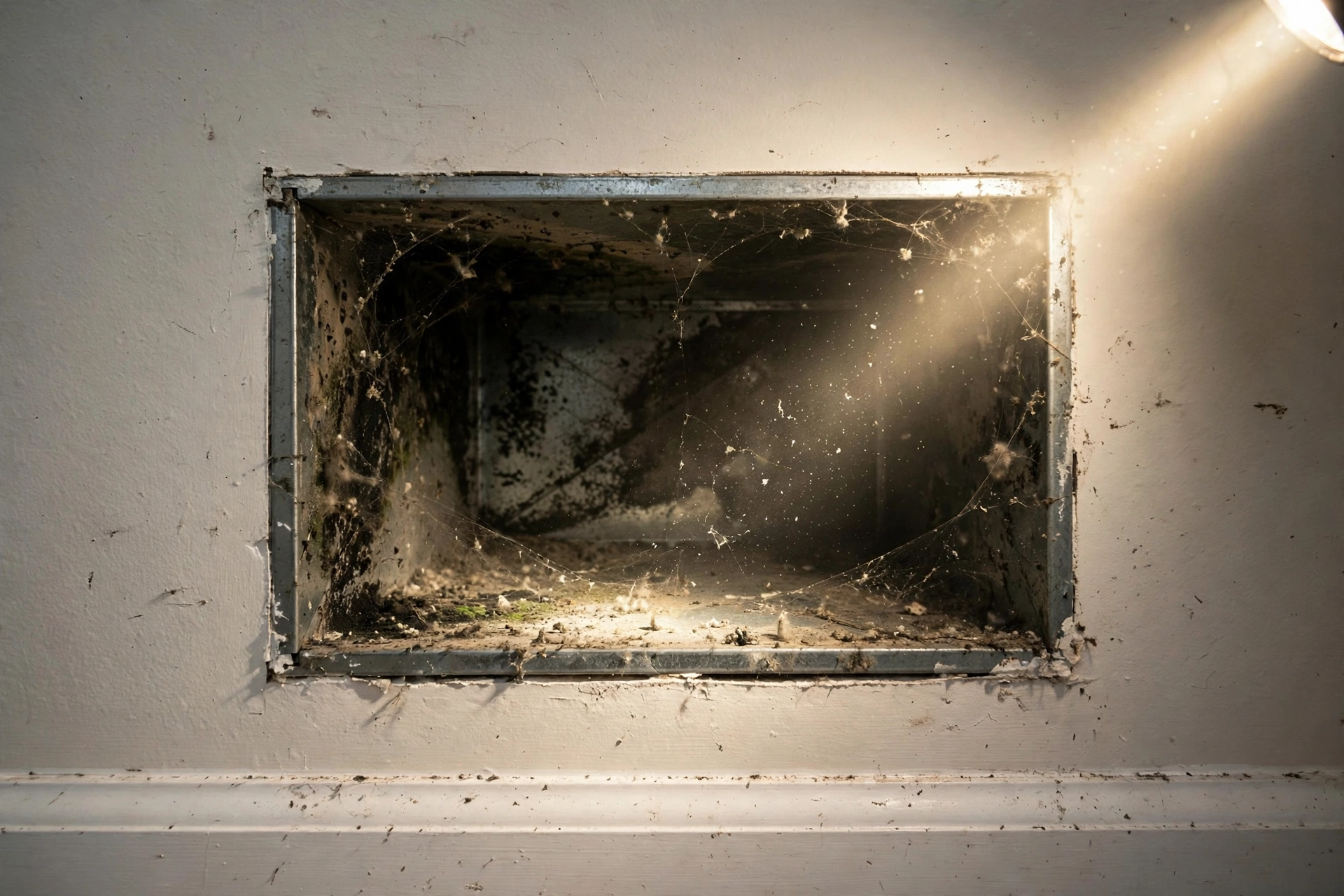
Every time the heat or AC kicks on, a musty smell rolls out of the vents. Your allergies are worse indoors, the kids cough at night, and you have started to wonder what is living inside the ductwork you never see. That suspicion is worth taking seriously.
Mold in air ducts is a real problem, though it is also one of the most oversold services in home maintenance. Some companies will happily sell you a duct cleaning you do not need, while actual duct mold goes undiagnosed because nobody looked. This guide covers how to tell the difference: the real signs, how testing works, what proper cleaning costs, and how to keep it from coming back.
How mold gets into ductwork
Ducts are dark, and the air moving through them carries dust, which is organic material mold can feed on. Add moisture, and you have everything mold needs. The moisture usually comes from condensation: cold supply ducts sweating in a humid attic or crawl space, a clogged condensate drain backing water into the air handler, or an oversized AC that cools the air without running long enough to dehumidify it.
The air handler itself is often the worst spot. The evaporator coil stays damp during cooling season, and the drain pan beneath it can hold standing water if the drain line clogs. From there, growth spreads onto nearby duct surfaces, especially flexible duct liner, which is porous and nearly impossible to clean once colonized.
Poor filtration makes everything worse. A missing or ill-fitting filter lets dust cake onto the coil and into the ducts, giving mold a food source throughout the system. The EPA’s indoor air quality guidance treats HVAC maintenance as a core part of healthy indoor air, not an optional extra.
Signs of mold in your air ducts
Home signs
- A musty or earthy odor from vents when the system runs, fading when it is off
- Visible dark spots or fuzzy growth on vent covers, registers, or just inside duct openings
- Black streaks or staining around supply vents on walls and ceilings
- Excessive dust blowing from vents, or dust that returns days after cleaning
- Condensation or water stains on or around ductwork, especially in attics and crawl spaces
- A history of water damage, high indoor humidity, or a clogged condensate drain
Health symptoms
The symptom pattern for duct mold looks like other mold exposure: sneezing, congestion, itchy or watery eyes, coughing, and worsening asthma, but with a distinctive timing. Symptoms flare when the HVAC runs and ease when it has been off for a while. If the whole family feels worse in summer when the AC runs constantly, the ducts deserve a look. Our overview of mold exposure symptoms covers the full range, and black mold health effects goes deeper on the mechanisms.
One caution: not every musty HVAC smell is mold in the ducts. A dirty evaporator coil, a dry drain trap, or a dead animal in the ductwork can all produce odors. Diagnosis means looking, not assuming.
How to confirm it: inspection and testing
Start with your own eyes. Pull off a few vent covers and shine a flashlight into the ducts as far as you can see. Check the air handler: open the access panel and look at the coil, drain pan, and blower compartment. Surface mold on a metal vent cover can be wiped; growth deep inside lined ducts is a bigger deal.
For a professional assessment, an HVAC contractor or indoor air quality specialist can scope the ducts with a camera, which shows the true extent of growth without guesswork. This typically costs $100 to $300 as a standalone inspection, and many companies credit it toward cleaning if you proceed.
Testing options include surface swabs of visible growth and air samples comparing indoor spore counts to outdoor baseline. Testing confirms what species are present and roughly how much is airborne, but it rarely changes the action plan: if there is visible growth inside the system, it needs to be cleaned or removed regardless of species. Our guide to mold test kits explains what DIY kits can and cannot tell you before you spend money on lab work.
What duct mold cleaning costs
Professional air duct cleaning for an average home typically runs $300 to $700, depending on the size of the system, number of vents, and region. That covers agitation and HEPA vacuum extraction of the ductwork under negative pressure, which is the industry-standard method.
Mold changes the price. If inspection finds actual growth, expect $500 to $1,200 or more for cleaning plus antimicrobial treatment of the system. Severely contaminated flexible ductwork often cannot be cleaned effectively and needs replacement instead, at roughly $15 to $25 per linear foot installed. A contaminated evaporator coil adds $100 to $400 for professional coil cleaning.
Be skeptical of $99 whole-house duct cleaning coupons. Proper duct cleaning takes several hours with truck-mounted or high-powered portable HEPA equipment. A crew that is in and out in 45 minutes did not clean your ducts; they vacuumed your vent covers. Get a written scope of work before anyone touches the system.
What proper cleaning actually involves
A legitimate duct mold job follows a sequence. The system gets shut down and put under negative pressure so dislodged contaminants go into the vacuum, not into your rooms. Technicians agitate the duct interiors with rotating brushes or air whips, extract everything with HEPA filtration, then treat remaining surfaces with an EPA-registered antimicrobial labeled for HVAC use.
Porous materials with heavy growth, like fiberglass duct liner or insulation inside the air handler, should be removed and replaced rather than cleaned. No chemical treatment restores contaminated porous material. After cleaning, the contractor should show you before-and-after camera footage; if they cannot, you have no proof the work happened.
Small jobs are DIY-able: removing vent covers and scrubbing them with detergent, wiping reachable duct surfaces, replacing the filter, and clearing the condensate drain line. Do not attempt to fog chemicals through the system yourself, and do not disturb large growth without containment; you will aerosolize spores throughout the house. The EPA’s mold resources emphasize fixing the moisture source as part of any cleanup, and ducts are no exception.
Keeping mold out of the ducts for good
Cleaning without fixing the moisture source guarantees a repeat job. The prevention checklist is unglamorous but effective.
- Keep indoor humidity between 30 and 50 percent; a good basement dehumidifier handles the dampest zone in most homes
- Change HVAC filters on schedule and make sure they fit without gaps
- Keep the condensate drain line clear; pour a cup of diluted bleach or vinegar through it a few times a year
- Insulate ducts in unconditioned attics and crawl spaces to stop condensation
- Fix roof and plumbing leaks promptly so water never reaches the system
- Have the evaporator coil professionally cleaned every few years
Health note: This article is for general information only and is not medical advice. If you have symptoms you think may be related to mold exposure, talk to a qualified healthcare provider.
Frequently Asked Questions
How do I know if the black stuff in my vents is mold or just dust?
Dust wipes away easily and is usually gray and uniform. Mold tends to look spotty, fuzzy, or slimy, often in irregular patches, and may smear rather than wipe clean. If it is growing on or around a damp area, treat it as mold until proven otherwise. A surface test kit can confirm, but visible growth in a damp location is enough reason to clean it.
Can mold in air ducts make you sick?
It can trigger the same allergic and irritant symptoms as mold elsewhere: congestion, coughing, itchy eyes, and asthma flare-ups. The duct location matters because the system distributes spores to every room each time it runs, so exposure can be higher than from a similar patch of mold on a wall. Sensitive individuals should take duct mold seriously.
How often should air ducts be cleaned?
There is no universal schedule; the EPA does not recommend routine duct cleaning for all homes. Clean them when inspection shows visible mold, vermin, or heavy dust buildup, or after major renovation or water damage. Annual visual checks of accessible components are more useful than scheduled cleanings.
Does homeowners insurance cover mold in air ducts?
Usually only if the mold resulted from a covered sudden event, like a burst pipe leaking into the ductwork. Gradual growth from humidity or neglected maintenance is typically excluded. Check your policy’s mold coverage limits, which are often capped separately from the main dwelling coverage.
Can I just spray bleach into the ducts?
No. Bleach is a poor choice for ductwork: it does not penetrate porous surfaces well, its fumes get distributed through the house by the blower, and it can corrode metal components. Physical cleaning plus an HVAC-labeled antimicrobial, applied by someone who knows the system, is the correct approach.
Will a UV light in the HVAC prevent duct mold?
UV-C lights installed at the coil can reduce microbial growth on the coil surface itself, which helps with one common source. They do not sterilize the entire duct system or compensate for high humidity. Consider one as a supplement to moisture control, not a replacement for it.
The bottom line
Mold in air ducts announces itself through musty odors when the system runs, visible growth at vents, and allergy symptoms with suspicious timing. Confirm with a visual inspection and a camera scope before spending money, then budget $500 to $1,200 for professional cleaning with antimicrobial treatment.
The cleaning is only half the job. Until humidity stays in the 30 to 50 percent range, filters fit properly, and the condensate drain flows freely, the mold will be back. Fix the moisture, clean the system, and verify with your eyes afterward; that sequence is what actually ends the problem.