

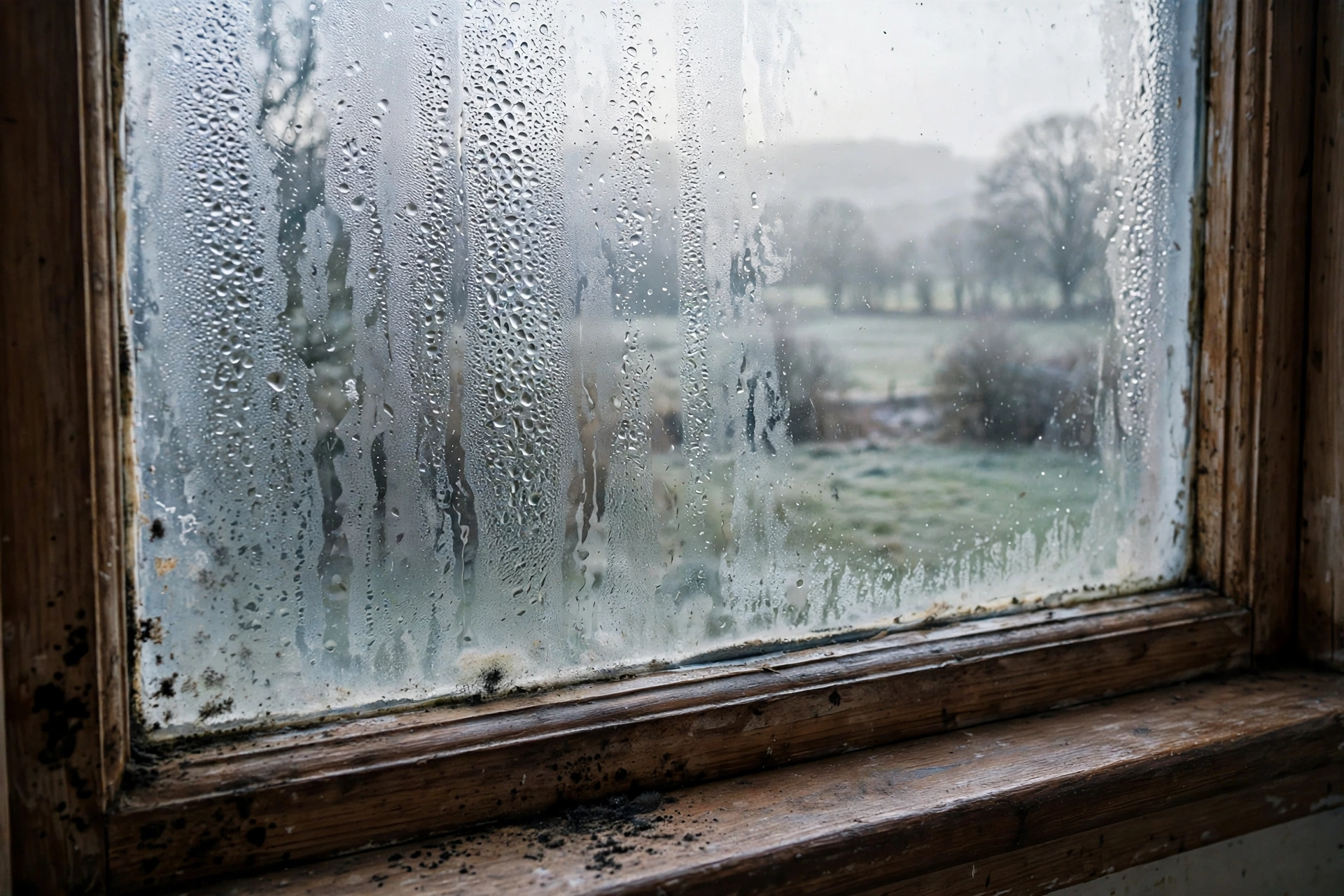
Morning condensation on windows looks harmless. A little fog on the glass, some droplets on the sill, gone by midday. But when it happens day after day through the cold months, those wet sills and frames become one of the most common household mold sites, and most homeowners never connect the daily fog to the black spots creeping along the window frame.
Window condensation mold is almost entirely preventable. The condensation itself is simple physics: warm, humid indoor air hitting a cold glass surface. You cannot change the physics, but you can change the conditions on both sides of the glass, and that is usually enough to stop the moisture before mold ever starts.
This guide explains why condensation forms, when it becomes a real mold problem, the daily routine that keeps windows dry, and which window upgrades actually solve the underlying issue.
Why condensation forms on your windows
Warm air holds more moisture than cold air. When warm indoor air meets a cold window surface, the air touching the glass cools down, cannot hold its moisture anymore, and deposits the excess as liquid water on the glass. The colder the glass and the more humid the air, the more condensation you get.
This is why condensation is worst in winter, when the outdoor side of the glass is coldest, and worst on single-pane or old double-pane windows with poor insulation. It is also why condensation concentrates in bathrooms, kitchens, and bedrooms: those rooms generate the most indoor humidity from showers, cooking, and people breathing all night with the door closed.
Modern airtight homes make this worse. Older drafty houses leaked humid air out constantly; well-sealed modern homes trap it. If your home smells damp anywhere else, our guide on tracking down a musty basement smell covers the same humidity-control principles for the rest of the house.
When condensation becomes a mold problem
Condensation on the glass is not mold. Mold starts where the water sits and stays: on the wooden or painted sill, in the corners of the frame, in the caulk lines, and behind blinds and curtains where airflow is blocked. Organic material (wood, dust, drywall, paint) plus persistent moisture plus time is the entire mold recipe, and a wet window sill supplies all three.
The threshold that matters is duration. A window that fogs for an hour each morning and dries completely is low risk. A window where the sill stays damp all day, where water pools at the bottom of the glass, or where condensation runs down and soaks the drywall below is a mold problem in progress. Black or dark green speckling on the sill or in the frame corners is the visible confirmation.
Bathrooms are the classic case. Hot showers pump enormous humidity into a small room, and bathroom windows are often the coldest surface in it. The EPA’s mold and moisture guidance explains how quickly mold establishes on damp surfaces, which is why sills that never fully dry are the real risk. If you have not addressed ventilation there, read our guide on how to prevent bathroom mold first, since a bathroom exhaust fan does more for window condensation than anything you can do to the window itself.
The daily routine that keeps windows dry
Fighting condensation is mostly about small daily habits rather than big projects. These are the habits that actually move the needle:
- Ventilate briefly but decisively: open windows across the house for 5 to 10 minutes each morning to flush humid air, even in winter. Short, full air exchanges dry the air far better than leaving one window cracked all day, and they cost less heat.
- Run bathroom and kitchen exhaust fans during and for at least 20 minutes after showers and cooking, since those activities are the biggest indoor moisture sources.
- Keep blinds and curtains open during the day and raised a few inches at night. Heavy curtains trap a pocket of cold air against the glass, which makes condensation dramatically worse. Airflow to the glass is your friend.
- Wipe down window sills and frames each morning when condensation is heavy. A quick pass with a towel or squeegee removes the water before it sits long enough to feed mold.
- Keep furniture away from exterior walls and windows so air can circulate. Sofas and beds pushed against outside walls create cold, still pockets where condensation and mold thrive unseen.
Keep indoor humidity in the 30 to 50 percent range
The long-term fix for condensation is controlling indoor humidity, not fighting each droplet. The EPA recommends keeping indoor relative humidity between 30 and 50 percent, and condensation problems usually live at the upper end of that range or above it.
Buy a $10 to $15 hygrometer and actually measure. Most homeowners guess their humidity wildly wrong, and the number tells you whether you have a ventilation problem or a window problem. If humidity sits above 50 percent most of the winter, ventilation and dehumidification are your fix. If humidity is in range and windows still fog heavily, the windows themselves are the weak link.
For whole-house humidity control, portable dehumidifiers work well in the dampest rooms. If your basement runs humid in winter too, our breakdown of the best basement dehumidifier options covers sizing and capacity. Other sources worth reducing: vent clothes dryers fully outdoors and avoid drying laundry indoors without ventilation.
Window-level fixes that reduce condensation
When humidity is under control but specific windows still sweat, these targeted fixes raise the glass temperature or manage the moisture at the surface:
- Window insulation film: the clear plastic kits that shrink tight with a hair dryer create a still air gap that measurably warms the inner surface. Cheap ($10 to $20 per window), ugly up close, but genuinely effective for a winter season.
- Trickle vents: small adjustable vents fitted into window frames that provide constant low-level background ventilation without opening the window. Common in newer windows and retrofittable in some frames.
- Weatherstripping and caulk: seal air leaks around the frame that let cold outdoor air wash over the glass edges and create cold spots. This is maintenance, not decoration.
- Storm windows: exterior storm panels create the same air-gap effect as insulation film but durably.
- Sill management: keep sills painted and sealed so incidental moisture cannot soak into bare wood, and make sure exterior caulk directs rain away from the frame instead of into it.
Condensation can also hide a bigger issue: water getting in from outside. If moisture appears around windows after rain rather than on cold mornings, the problem may be failed flashing or caulk letting rain in, which soaks framing in ways surface condensation never will.
When new windows are the real answer
Sometimes the windows are simply past helping. Single-pane windows in cold climates will condense at almost any reasonable humidity level. Double-pane units with failed seals (visible fog or haze between the panes that never clears) have lost their insulating gas and behave like single panes.
Replacement with modern double or triple-pane low-E windows typically costs $300 to $1,000 per window installed, more for large or custom units. That is real money, and it is worth weighing against the alternatives: if two windows condense and the rest of the house is fine, targeted replacement makes sense. If every window in the house sweats, the house has a humidity problem, not a window problem, and new windows will condense too until the humidity comes down.
One more consideration: concrete and masonry near windows can complicate mold cleanup. If condensation has been feeding mold on painted concrete sills or basement windows, our guide on mold on concrete floors covers cleaning techniques for masonry surfaces, which differ from wood and drywall.
The EPA recommends maintaining indoor relative humidity between 30 and 50 percent to control mold, dust mites, and other indoor air quality problems, which is the single most useful number for fighting window condensation, per its indoor air quality guidance.
Frequently Asked Questions
Is condensation on windows a sign of a serious problem?
Not by itself. Some condensation on cold mornings is normal physics. It becomes a problem when sills stay wet for hours daily, water pools or runs down the glass, or you see mold speckling on frames and sills. Persistent wetness, not occasional fog, is the line.
Will wiping condensation off actually prevent mold?
Yes, for the surfaces you wipe. Mold needs sustained moisture over a day or more to establish. Removing standing water from sills each morning denies it that window of time. It does not fix the humidity imbalance causing the condensation, but it reliably breaks the moisture-mold chain on the glass and sill.
What humidity level stops window condensation?
There is no universal number because it depends on glass temperature, but most homes see major improvement dropping from above 50 percent into the 30 to 45 percent range. A hygrometer tells you where you stand.
Do dehumidifiers help with window condensation?
Yes, in the rooms where they run. A properly sized dehumidifier pulls indoor humidity down into the target range, which directly reduces condensation on cold glass. Place it in the dampest rooms, typically laundry areas and basements, rather than expecting one unit to cover a whole house.
Should I replace my windows or fix my humidity first?
Fix humidity first. Measure with a hygrometer and get the house into the 30 to 50 percent range. If condensation persists at healthy humidity on specific windows, those windows are the weak link and replacement is reasonable.
What to do next
Start with the free stuff this week: get a hygrometer, ventilate for 10 minutes each morning, run exhaust fans properly, and wipe sills on heavy-condensation mornings. Most window condensation mold problems improve dramatically once you know your humidity number and build the ventilation habit.
If humidity stays stubbornly high despite good ventilation, look at the house-level moisture sources: under-ventilated bathrooms, damp basements, and unvented dryers are the usual suspects. Our guide to choosing the best basement dehumidifier is a good starting point for the basement side of the equation, and a hygrometer will tell you within a few days whether your changes are working.