

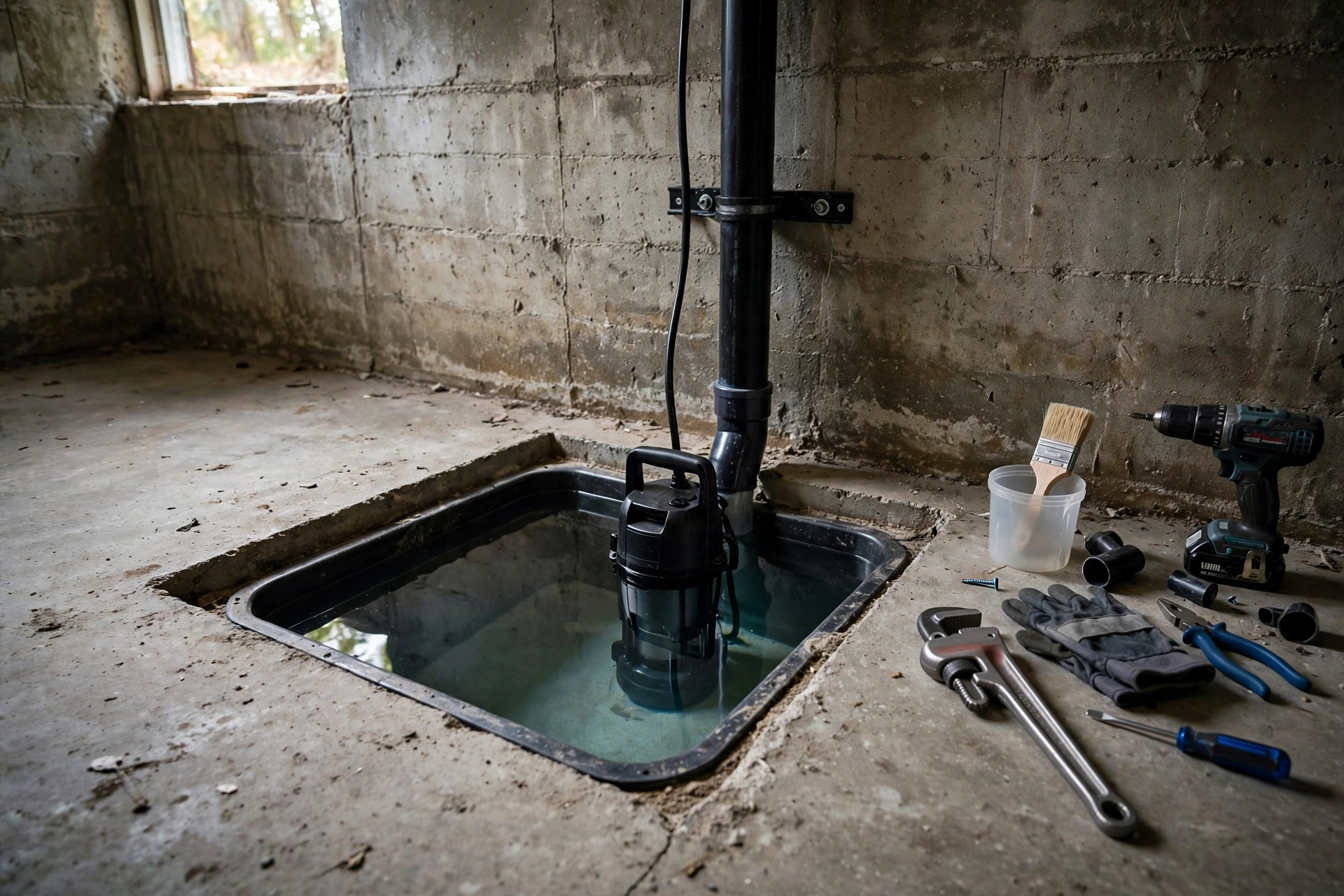
A sump pump is one of the cheapest insurance policies a basement can have. For a few thousand dollars installed, it moves groundwater away from your foundation before it ever reaches your floor. Skip it, and a single heavy storm can leave you shopping for new carpet, drywall, and a dehumidifier instead.
This guide breaks down what sump pump installation actually costs in 2026, what drives the price up or down, and where it makes sense to spend extra (battery backup) versus save (doing the digging yourself).
Average sump pump installation cost in 2026
Most homeowners pay between $1,000 and $2,500 for a professional sump pump installation, including the pump, basin, labor, and discharge line. The national average lands near $1,600 for a standard submersible pump in an existing home.
That range assumes a straightforward job: a contractor cuts a hole in the basement slab, sets a basin, installs the pump, and runs a discharge pipe outside. Costs climb when the job gets complicated, which we will cover below.
- Budget install (pedestal pump, simple setup): $800 to $1,200
- Standard install (submersible pump, new pit): $1,200 to $2,000
- Premium install (submersible + battery backup + sealed cover): $2,000 to $3,500
- Pump replacement only (pit already exists): $400 to $900
If your basement has flooded before, compare these numbers against a typical water damage restoration cost for a basement, which often runs several times higher. The pump usually pays for itself the first time it prevents a flood.
What drives the price up or down
Two identical pumps can cost very different amounts to install depending on the house. These are the factors contractors price around.
Digging the pit
Breaking through a concrete slab and excavating the pit is the most labor-intensive part. Thick slabs, rebar, or a high water table that floods the hole as you dig all add time. In a new build where the pit is roughed in during construction, installation can cost half as much.
Pump type and horsepower
Pedestal pumps (motor above the pit) cost $150 to $300 for the unit and are easier to service, but they are louder and less powerful. Submersible pumps ($200 to $500 for the unit) sit inside the pit, run quieter, and handle higher volumes. For most basements, a 1/3 or 1/2 HP submersible is the sweet spot.
Discharge line routing
The discharge pipe has to carry water well away from the foundation, ideally 10 to 20 feet out. Long runs, frozen ground concerns, or tying into an existing drain line add materials and labor. In cold climates, a freeze-resistant discharge setup is worth specifying.
Electrical work
The pump needs a dedicated GFCI outlet near the pit. If one does not exist, an electrician may charge $150 to $400 to add it. Battery backup systems also need proper wiring.
Permits and local codes
Some municipalities require a permit for sump pump installation or restrict where discharge water can go (never into the sanitary sewer in most areas). Permit fees are usually modest, $50 to $150, but check before work starts.
Battery backup: the add-on worth considering
Storms that flood basements often knock out power at exactly the wrong moment. A battery backup system kicks in when the power fails, running the pump for 6 to 12 hours depending on the battery and inflow.
Adding a battery backup during the initial install typically costs $400 to $900 extra, including the battery, charger, and secondary pump. Adding one later costs more because of the return trip. If your area loses power during storms, this is the single most valuable upgrade. Some homeowners pair it with a water-powered backup pump instead, which runs on municipal water pressure and needs no battery, though it uses a lot of water and is not allowed everywhere.
Smart monitors and Wi-Fi alarms ($50 to $150) are a cheaper layer of protection. They text you if water rises in the pit or the pump loses power, which matters if you travel.
DIY vs hiring a pro
Handy homeowners sometimes install their own sump pump for $300 to $700 in materials. The work itself is not mysterious: cut the slab, dig, set the basin in gravel, connect the pump and discharge, and wire the outlet.
The catch is the concrete work. Renting a jackhammer, cutting cleanly, and hauling debris is heavy, dusty labor, and mistakes in the discharge routing can send water right back toward the foundation. Most people find the $800 to $1,500 in labor worth paying, especially since pros warranty their work.
A reasonable middle ground: do the finish work yourself (like extending the discharge line grading) and let a plumber or basement contractor handle the pit and pump. If your basement already has a pit from a previous pump, replacing the pump itself is a very manageable DIY job.
Sump pump vs full waterproofing
A sump pump manages water that reaches the pit, but it does not stop water from entering through wall cracks or the floor joint. If you get water seepage in multiple spots, a sump pump alone may not be enough.
That is when homeowners look at interior drain tile systems or exterior waterproofing, which are bigger projects with bigger price tags. Our basement waterproofing cost guide compares interior versus exterior systems so you can see where a sump pump fits in the bigger picture. In many homes, the right answer is a sump pump plus sealed wall cracks plus good exterior grading, not one silver bullet.
Ongoing maintenance costs
A sump pump is not install-and-forget equipment. Budget a little time and money each year:
- Test the pump every few months by pouring water into the pit until the float triggers.
- Clean the pit of silt and debris annually so the float switch does not jam.
- Replace the battery in backup systems every 3 to 5 years ($150 to $300).
- Expect the pump itself to last 7 to 10 years; budget $400 to $900 for eventual replacement.
- Check the discharge outlet outside each spring to make sure it is not blocked or frozen shut.
Neglected pumps fail silently, and you only discover it during the storm. The EPA notes that controlling moisture quickly is the key to preventing mold growth after any water intrusion (EPA guide to mold, moisture, and your home), which is exactly what a working pump does.
When a sump pump is not enough
Call a basement professional rather than just adding a pump if you see bowing walls, wide horizontal cracks, or water entering through the middle of the floor under pressure. Those can signal structural or hydrostatic pressure problems that need a broader fix.
Also, if your basement has flooded more than once despite a working pump, the system may be undersized for your water volume, or the discharge may be recycling water back to the foundation. A second pit on the opposite side of the basement sometimes solves what a bigger single pump cannot.
For sudden plumbing failures rather than groundwater, the playbook is different: see our guide on burst pipe water damage for immediate steps and repair costs. And if mold has already taken hold from past flooding, check mold remediation cost per square foot so you can budget the cleanup too.
Frequently Asked Questions
How long does sump pump installation take?
A standard professional installation takes one day, usually 4 to 8 hours. Complex jobs with long discharge runs or electrical upgrades can stretch to two days.
Do I need a sump pump if my basement has never flooded?
Not necessarily, but consider your risk: high water table, poor exterior grading, or neighbors with pumps are all hints. Many homeowners install one proactively after finishing a basement, since finished space multiplies the cost of any future flood.
Can a sump pump handle a finished basement?
Yes, and finished basements are the strongest case for one. Pair the pump with a battery backup and a water alarm so a power outage does not ruin drywall and flooring.
How much does it cost to replace just the pump?
If the pit, basin, and discharge line are already in place, replacing the pump unit typically costs $400 to $900 installed, or $150 to $500 for the pump alone if you DIY.
Where should the discharge water go?
At least 10 to 20 feet from the foundation, downhill if possible, and never into the sanitary sewer (most codes prohibit it). Some areas require discharge to daylight or a storm drain.
Are there alternatives to a sump pump?
Exterior grading, French drains, and waterproof membranes reduce water pressure, but in high water table areas a sump pump is usually still the most reliable line of defense. They work best in combination.
Bottom line
Budget $1,000 to $2,500 for a professional sump pump installation in 2026, and strongly consider adding battery backup if storms knock out your power. Get two or three quotes, confirm the discharge plan and warranty in writing, and test the system twice a year. Compared with the cost of restoring a flooded basement, it is one of the best dollars-per-protection upgrades a homeowner can buy. For broader moisture strategy, the IICRC publishes the industry standards that reputable basement contractors follow.