

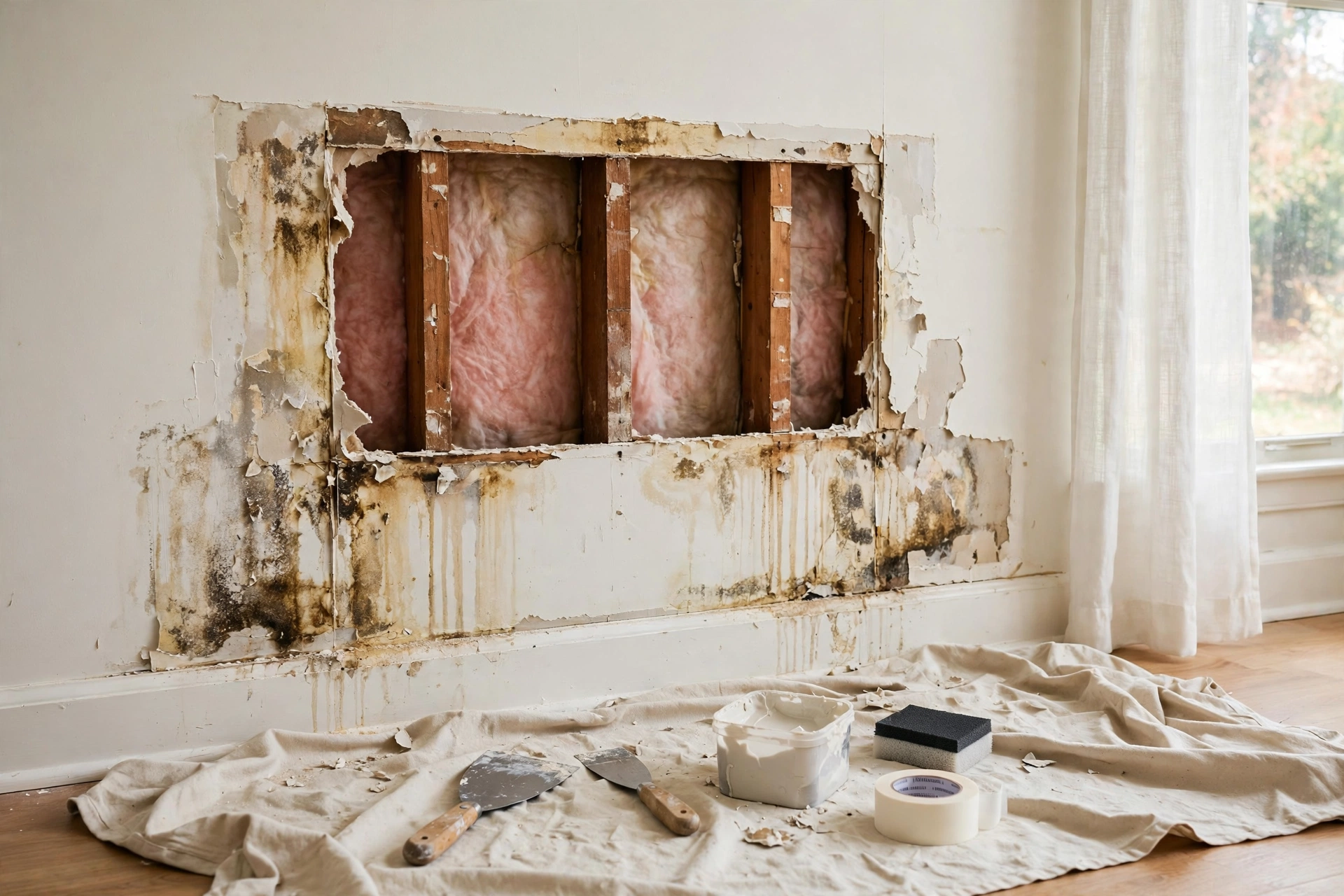
A water stain on drywall looks like a small cosmetic problem. You paint over it, it bleeds back through, and then one day the surface feels soft when you press it. That is when the real question arrives: how much is this going to cost to fix?
The honest answer is that drywall water damage repair cost depends on what the water did behind the surface, not what it looks like on top. A stain that dried out in a day might need a $150 patch. Drywall that sat wet for weeks could mean cutting out whole sections, replacing insulation, and treating mold, pushing the bill into the thousands.
This guide breaks down the three repair paths, patch, panel replacement, and full tear-out, with realistic U.S. price ranges for each. You will learn what drives the price up, when DIY makes sense, and when insurance might pick up the tab.
Patch, replace, or tear out: the decision that sets the price
Before any dollar figure makes sense, you need to know which repair category you are in. Water damage to drywall is not one job with one price. It is three different jobs, and the difference between them is how far the water got.
Patch it: damage is small and surface-only
A patch is the right call when the stain is under a couple of square feet, the drywall still feels firm when you press it, and the water source has been fixed. The contractor cuts a small clean rectangle around the stain, screws in a patch piece, tapes the seams, and finishes it to match. This is cosmetic-level work, and it only works if the gypsum core never went soft.
If the drywall feels spongy, crumbles under your thumbnail, or the paper facing bubbles and peels, you are past patching. Patches over compromised drywall fail and trap whatever is growing behind them. If you are not sure how bad the wall is, check the signs of water damage in walls before deciding.
Replace a section or full panel: the drywall is saturated
Once drywall has absorbed enough water to go soft, sag, or warp, drying it out does not restore it. Gypsum loses its structural strength when saturated, and it stays a mold risk even after it feels dry. The fix is to cut out the damaged area, usually a full 4 by 8 foot panel or a clean section between studs, and hang new drywall.
This is the most common scenario after a supply-line leak, an appliance overflow, or a roof leak that dripped for a while. Water wicks further than the visible stain, so expect the cut-out to run a foot or more beyond the discoloration. Contractors confirm the true extent with a moisture meter before cutting.
Full tear-out: damage is widespread or mold is involved
A tear-out is what it sounds like: removing all affected drywall in the room to expose framing, insulation, and plumbing. This happens when flooding reached the walls, when mold has grown behind the drywall, or when the leak ran long enough that insulation is soaked and framing shows moisture damage.
Tear-outs are bigger jobs because they include demolition, drying the cavity with professional equipment, replacing insulation, treating or replacing framing, then re-hanging, finishing, and painting.
National cost ranges for each repair type
Here is what homeowners typically pay, based on what the job involves. These are ballpark ranges, not quotes; labor rates vary a lot by metro area, and every wall is its own situation.
Small patch, clean water, no framing damage: $150 to $500. This covers the cut-out, patch, tape, texture match, primer, and paint on a small section. Most contractors have a minimum service charge, so even a tiny patch rarely lands under $150.
Moderate section replacement with some insulation work: $500 to $1,200. This covers a larger cut-out, new insulation, a framing check, the new panel, and finishing.
Ceiling section with water damage: $350 to $1,500. Overhead work runs slower, needs containment for falling dust and debris, and often needs the popcorn or knockdown texture matched. See our dedicated ceiling water damage cost guide for what drives ceiling quotes specifically.
Full room tear-out: $1,500 to $5,000. This covers demolition, structural drying, multiple panel replacements, new insulation, finishing, and a full repaint. If mold remediation is needed behind the walls, add $500 to $2,000 or more on top.
For context on how these numbers fit into a bigger restoration job, see our full water damage restoration cost breakdown, which covers drying, demolition, and rebuild across whole rooms.
Four factors that push your price up or down
1. Mold behind the wall
Mold is the single biggest cost multiplier. If the contractor opens the wall and finds active growth, the job stops being a drywall repair and becomes a remediation project: containment, HEPA filtration, removal of contaminated materials, and antimicrobial treatment. The CDC’s mold and health guidance notes that damp indoor environments can trigger health issues, which is why pros take containment seriously rather than just wiping mold off. Expect the remediation portion to add $500 to $2,000 for a contained area, more for widespread growth.
2. Wet insulation and damaged framing
Fiberglass insulation that got soaked is not worth drying; it gets pulled out and replaced at roughly $1 to $2.50 per square foot installed. Framing lumber that stayed wet long enough to soften needs treatment or, in bad cases, sistering with new lumber.
3. Texture matching and full-wall repaint
A patch-only quote covers the repaired section. One that includes painting the full wall corner to corner for a seamless match runs $200 to $400 more per wall, and texture matching adds labor, especially for heavy textures. Before comparing bids, confirm which scope each number covers; a cheap quote that skips paint is not actually cheaper.
4. Location and access
Walls in finished basements, bathrooms, and behind built-ins cost more because of extra teardown and restoration. Bathrooms add plumbing fixture handling and moisture-resistant drywall, while basement walls can hide insulation and vapor barrier details that must be rebuilt correctly.
DIY drywall repair: when it makes sense and when it does not
A small, clean-water patch is one of the more DIY-friendly repairs. A drywall saw, utility knife, mesh tape, joint compound, and a couple of tutorial videos will get a competent homeowner through it for $30 to $80 in materials. Our guide on how to fix water damage on walls covers the process step by step.
Draw the DIY line at these points: anything bigger than a couple of square feet, any ceiling work, any suspected mold, or any job where you cannot confirm the water source is fixed. Panel replacement is doable for handy homeowners, but finishing seams to a professional standard takes practice.
Never DIY a tear-out that might involve mold without proper protection. Disturbing mold colonies without containment spreads spores through the house, and drywall dust itself is a respiratory irritant. At minimum, that means an N95 respirator, goggles, gloves, and plastic sheeting to isolate the work area.
Will homeowners insurance cover drywall water damage?
Often, yes, but it depends entirely on how the water got there. Insurance typically covers sudden and accidental events: a burst pipe, a failed water heater, a storm-driven roof leak. It does not cover gradual damage from neglect, like a slow plumbing leak you knew about for months, or seepage from poor drainage.
Two things to know before filing. First, your deductible applies, so a $400 patch on a $1,000 deductible policy is out of pocket anyway. Second, document everything before repairs start: photos of the damage, the source, and any affected belongings.
The EPA advises that porous materials like drywall be dried within 24 to 48 hours to prevent mold growth, which is why fast action matters far more than fast cosmetic repairs, according to its brief guide on mold, moisture, and your home.
Frequently Asked Questions
How much does it cost to repair water-damaged drywall per square foot?
Per-square-foot pricing usually lands between $2 and $10: minor patches at the low end, full replacement with finishing and paint at the high end.
Does wet drywall always need to be replaced?
Not always. Drywall that got splashed and dried within a day or two while staying firm can often be patched and painted. Drywall that went soft, sagged, crumbled, or grew mold has to come out. A decent rule of thumb: if you can push your thumbnail into the gypsum core, that panel is done.
How long does a drywall water damage repair take?
A small patch typically takes a day or two of visits, mostly waiting on joint compound to dry between coats. A panel replacement runs two to four days. A full tear-out with drying equipment and remediation can take one to three weeks.
Can I just paint over water-stained drywall?
You can, but the stain will almost always bleed back through regular paint. If the drywall is confirmed dry and firm, use an oil-based or shellac stain-blocking primer, then paint. If the drywall is soft or the source is still active, paint is a cover-up that guarantees a bigger bill later.
Why did my contractor’s quote double after opening the wall?
Because water damage hides. The cavity can hold soaked insulation, mold, or damaged framing that no estimate can predict without opening the wall. Budget a contingency of 20 to 30 percent, and do not let anyone seal up a damp wall cavity.
Is mold remediation included in a drywall repair quote?
Usually not. Most drywall quotes cover removal and replacement of the drywall itself. Remediation, meaning containment, HEPA air scrubbing, and antimicrobial treatment, is typically a separate line item or a separate contractor.
The bottom line
Drywall water damage repair runs from roughly $150 for a small patch to $5,000 or more for a full tear-out with remediation, with most real-world jobs landing between $500 and $1,500. The number that matters is not the stain on the surface; it is what the moisture meter says inside the wall cavity.
Your next moves, in order: stop the water source, document the damage with photos, check for soft spots and mold, and get two or three quotes that state the exact scope.