

If your basement takes on water every spring, you have probably heard a waterproofing contractor pitch an interior French drain. It is one of the most recommended fixes for basement seepage, and also one of the bigger checks a homeowner writes for waterproofing. So what should it actually cost?
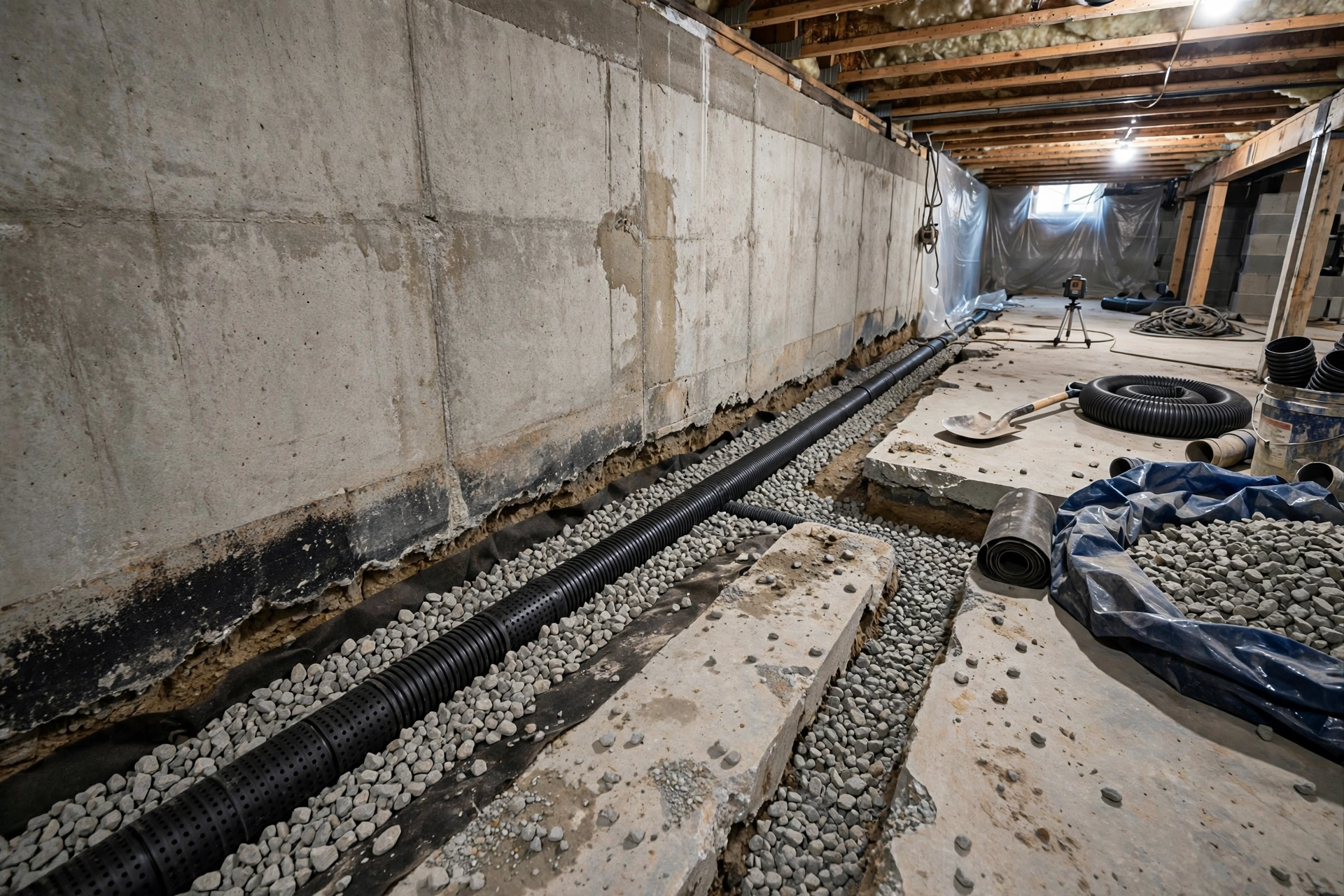
An interior French drain, sometimes called a perimeter drain or drain tile system, is a trench cut into the basement floor around the foundation walls. Perforated pipe sits in gravel inside the trench, collects water that seeps in, and routes it to a sump pump, which ejects it outside. It does not stop water from reaching your foundation; it manages the water after it arrives.
This guide covers realistic interior French drain installation cost ranges in the U.S., what is included in a typical quote, the add-ons that change the price, and how it compares to other basement waterproofing options.
How much does an interior French drain cost?
For most homes, a professionally installed interior French drain system runs $3,000 to $8,000 for a full basement perimeter. Contractors usually price it per linear foot: expect $40 to $85 per linear foot, including the trench, pipe, gravel, sump pit, and pump.
The math checks out for a typical basement. A 1,200 square foot basement has roughly 140 linear feet of perimeter. At $50 per foot, that lands around $7,000 before add-ons. Partial systems, just one or two walls, cost less but leave the rest of the perimeter unprotected, which contractors will point out when they quote.
These ranges assume professional installation with a warranty. A full quote almost always includes the sump pump, but confirm that in writing; some contractors itemize the pump separately.
What is actually included in the price
Understanding the scope helps you compare quotes honestly. A complete interior French drain installation typically includes several distinct steps, each with labor and materials behind it.
- Trenching: cutting and removing a strip of concrete floor, usually 12 to 18 inches wide, around the interior perimeter.
- Pipe and gravel: perforated PVC or corrugated pipe bedded in washed gravel, wrapped in filter fabric to resist clogging.
- Sump pit and pump: a basin set at the low point, a primary pump, and discharge piping run outside the house.
- Concrete restoration: pouring new concrete over the trench to restore the floor surface.
- Wall flange or vapor barrier: many systems include a plastic membrane on the wall that directs seepage down into the drain.
If your basement is finished, add demolition and restoration of the finished walls and flooring on top of the drain price. That is a common surprise line item, so ask about it before signing.
Seven factors that change your quote
1. Linear footage
This is the main driver. More perimeter means more trenching, more pipe, and more concrete work. A full perimeter job on a large or L-shaped basement costs proportionally more than a simple rectangular one.
2. The sump pump setup
A basic primary pump adds a few hundred dollars. Most pros recommend a battery backup pump too, because the storms that flood basements also knock out power; a backup system adds $300 to $600. High-capacity or dual-pump setups push higher. Skipping the backup to save money is a common regret after the first outage.
3. Concrete thickness and access
Thick old slabs take longer to cut. Basements with limited access for equipment, or with finished walls tight to the foundation, take more labor. Tight access can add several hundred dollars to a quote.
4. Foundation wall type
Poured concrete walls are straightforward. Block walls need weep holes drilled at the base of each block core so water trapped inside the blocks can drain into the system, which adds labor. Stone or rubble foundations are the most expensive to work around.
5. Radon and discharge rules
Some areas require sealed sump systems with radon mitigation connections, and many municipalities restrict where discharge water can go. Check local rules before work starts; a discharge line that violates code gets expensive to redo.
6. Permits and inspections
Many jurisdictions require a permit for drainage and sump work, typically $100 to $300. A contractor who skips permits is not saving you money; they are creating a problem for a future home sale.
7. Warranty terms
Established waterproofing companies charge more partly because they offer transferable lifetime warranties. A cheaper quote with a one-year warranty is not the same product as a pricier one that stands behind the system for decades. For a system buried under your floor, the warranty matters.
Interior versus exterior French drains
An exterior French drain is installed outside, around the foundation footing, and intercepts water before it reaches the wall. It is the more thorough solution in theory, but it requires excavating down to the footing, which means heavy equipment, landscaping destruction, and prices that often run $10,000 to $20,000 or more.
Interior systems are cheaper because there is no excavation around the house, and they are installed in one to two days with minimal disruption. The trade-off is that water still reaches your foundation wall; the system just manages it. For most homes with seepage rather than structural wall failure, the interior system is the practical choice.
If you are weighing the drain against other options, our basement waterproofing cost guide compares interior drains, exterior excavation, wall sealants, and sump systems side by side.
Can you DIY an interior French drain?
Technically yes, and materials for a DIY interior drain run roughly $1,000 to $2,500 for pipe, gravel, fabric, a pump, and concrete. In practice, very few homeowners should attempt it. The work involves cutting concrete, hauling out rubble, maintaining proper slope on the pipe, and pouring a floor that does not look like a patch job. Mistakes get buried under concrete, where they are expensive to fix.
The realistic DIY middle ground is everything around the system: grading soil away from the foundation, extending downspouts, and managing surface water. Those fixes are cheap and sometimes solve mild seepage on their own. But once you need a trench in the slab, hire it out.
What a French drain does not fix
A perimeter drain handles groundwater seepage through the floor-wall joint. It does not fix water coming through wall cracks above the floor, failed window wells, or plumbing leaks. Those need their own repairs, which is why a good contractor inspects before quoting.
It also does not remove mold that is already growing. If your basement has been wet long enough to grow mold on walls or stored items, the drain is step two. Step one is drying out the flooded basement and dealing with contaminated materials. After the system is in, follow through with mold prevention steps for basements like dehumidification and humidity monitoring.
The EPA notes that homeowners should take steps to reduce flood risk and moisture intrusion, and that standing water and damp materials should be addressed quickly after flooding to limit damage, per its guidance on flooding and Ready.gov’s flood safety resources.
Frequently Asked Questions
How long does an interior French drain last?
A properly installed system with filter fabric typically lasts 30 to 40 years. The sump pump is the weak link and usually needs replacement every 7 to 10 years. Systems without fabric clog with silt much sooner, which is why fabric-wrapped installations are worth specifying.
Does a French drain need a sump pump?
In almost all residential installations, yes. The drain collects water, and the pump moves it up and out. The only exception is a home with enough natural slope for a gravity daylight drain, which is rare in suburban lots. Budget for the pump as part of the system, not as an optional extra.
Will a French drain keep my basement completely dry?
It handles groundwater seepage, which is the most common cause of wet basements, very well. It will not stop wall cracks above the drain line, window well flooding, or plumbing leaks. A complete solution usually pairs the drain with crack repair, grading, and downspout extensions.
How long does installation take?
Most interior perimeter systems go in over one to two days for an average basement, plus concrete cure time before you can use the floor normally. Exterior systems take a week or more because of the excavation and backfill.
Is a French drain covered by homeowners insurance?
Almost never as a preventive upgrade; insurers do not pay for waterproofing improvements. If you are dealing with damage from a covered event, our flooded basement cost guide explains what insurance typically covers and what it does not.
How much does it cost to add a battery backup sump pump?
A battery backup pump system typically adds $300 to $600 to the job, including the pump, battery, and charger. Given that the storms causing basement flooding often cause power outages, it is one of the highest-value add-ons in waterproofing.
The bottom line
Budget $3,000 to $8,000 for a professionally installed interior French drain on a typical basement, priced at roughly $40 to $85 per linear foot. Add a battery backup pump, confirm the quote includes concrete restoration and the pump itself, and compare warranty terms, not just price.
Get three quotes from established waterproofing contractors, and be wary of any bid dramatically lower than the others; it usually means a thinner scope, no warranty, or a system that will clog in a decade. A drain that works for 30 years is cheap insurance against repeat floods and the mold that follows them.