

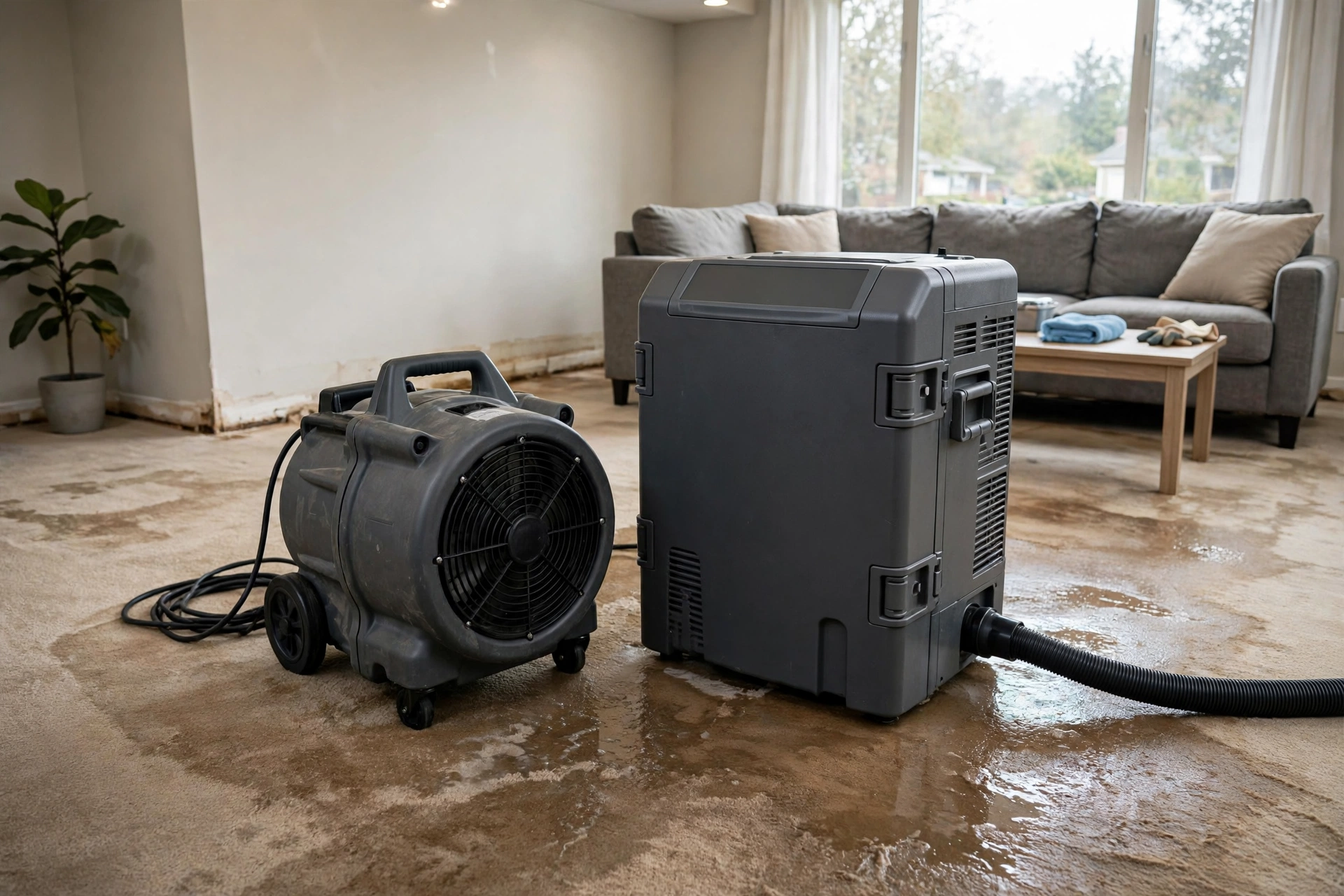
Walk into a professionally dried home and you will see two kinds of machines: the snail-shaped fans called air movers, and the boxy dehumidifiers humming beside them. Homeowners often ask which one matters more, or whether they can get by with just one. The professional answer is that they are not alternatives. They are two halves of one system, and drying stalls when either half is missing.
This guide explains what each machine actually does, why they need each other, how pros size and place them, and the mistakes that make drying take twice as long as it should.
What an air mover does
An air mover is a high-velocity fan designed to push air across wet surfaces at floor level. Its job is evaporation: moving dry air over a wet surface breaks up the thin layer of saturated air clinging to the material, which lets moisture release from the material into the room air faster. Without airflow, that boundary layer sits undisturbed and evaporation crawls.
Placement is specific. Pros angle air movers so the airflow skims across the surface at a shallow angle, often in a daisy-chain pattern where each unit feeds the next around the room. Air aimed straight down at one spot does far less than air sweeping across a broad surface. One unit typically covers 150 to 200 square feet, plus dedicated units aimed at wet wall bases and under pulled-back carpet.
What a dehumidifier does
A dehumidifier does the opposite job: it pulls moisture out of the room air and drains it away. As air movers drive evaporation, room humidity climbs, and humid air slows further evaporation. The dehumidifier keeps the air dry enough for evaporation to continue, which is why drying without one stalls: the room air becomes saturated and the air movers start circulating wet air.
Pros use refrigerant or desiccant commercial units rated in pints per day, far beyond residential capacity. The IICRC, the body that writes the industry’s drying standards, trains technicians to size dehumidification to the volume of the space and the class of water loss, not to guess. The target is keeping indoor humidity in the drying zone, generally trending down toward the EPA’s recommended 30 to 50 percent range as the job progresses.
Why you need both
The system works as a loop. Air movers push moisture off surfaces into the air. Dehumidifiers pull that moisture out of the air and send it down a drain. Break either half and the loop fails: air movers alone just redistribute humidity around the house, and a dehumidifier alone can only process the moisture that reaches the air on its own, which is slow.
This is the most common DIY drying mistake. A homeowner rents or buys a dehumidifier, sets it in the middle of the wet room, and waits. The air near the machine dries, the surfaces stay wet, and a week later the moisture meter still reads high. Adding air movers, even inexpensive rentals at $20 to $30 per day per unit, often cuts the remaining drying time in half.
The reverse mistake happens too: blasting fans with no dehumidification in a sealed, humid room. Evaporation raises the room’s humidity until the air cannot accept more moisture, and drying plateaus. In dry climates with open windows, fans alone can sometimes finish a small job. In humid conditions or closed spaces, both machines are mandatory.
How pros size the equipment
Professionals start from the water, not the room. They classify the loss by how much water the materials absorbed and how much surface area is wet, then calculate dehumidifier capacity and air mover counts from that. A clean-water leak affecting one room might get two air movers and one large dehumidifier. A flooded basement might get a dozen air movers and multiple commercial dehumidifiers.
For a homeowner renting equipment, the practical rules are: one air mover per 150 to 200 square feet of wet area, one per wet wall base, and a dehumidifier rated at least 50 pints per day for a room or 70-plus pints for larger spaces. When in doubt, slightly oversize the dehumidifier; an undersized unit running for two weeks costs more in rental fees and mold risk than the right unit running for five days.
Extraction comes before all of this. No amount of air movement substitutes for physically removing standing water and pulling moisture out of carpet and pad with an extractor. See our water extraction cost guide for what professional extraction runs and when the rental math favors DIY.
Placement and setup that pros get right
Close the space. Doors and windows shut, HVAC vents in the zone closed, so the equipment conditions the smallest possible volume of air. Position air movers to create continuous airflow across every wet surface, with air entering from the driest part of the room and pushing toward the dehumidifier’s intake.
Set the dehumidifier centrally with its intake facing the wettest zone, and rig continuous drainage to a floor drain, sink, or sump pit. A unit that shuts off on a full bucket at night loses the most valuable drying hours. Run everything 24 hours a day: shutting down overnight lets humidity rebound and materials reabsorb moisture.
Monitor daily with a moisture meter and a hygrometer, and adjust placement as the job progresses. Wet zones shrink as drying proceeds, so equipment that was perfectly placed on day one may need repositioning on day three. Our guide to how long to run a dehumidifier after water damage explains the readings-based shutoff test in detail.
Mistakes that stall drying
- Running air movers without a dehumidifier in a closed, humid space.
- Running a dehumidifier with no air movement across the wet surfaces.
- Opening windows on a humid day, feeding outdoor moisture into the drying space.
- Pointing air movers straight down or at walls instead of skimming across surfaces.
- Shutting equipment off at night to save electricity.
- Never repositioning equipment as wet zones shrink.
- Stopping based on how the room feels instead of meter readings.
What professional drying typically takes
With both machines correctly sized and placed, most residential water losses reach dry readings in 3 to 5 days. Larger or more saturated losses take 5 to 10 days. These timelines assume extraction happened first and the water source is stopped; active leaks and skipped extraction stretch every timeline. Our water damage restoration timeline guide breaks down each phase from emergency response through rebuild.
For whole-house scenarios, the equipment counts scale up fast, which is where professional crews earn their fee: they arrive with a truck full of matched equipment and the meters to manage it. A flooded basement is the classic case where DIY equipment rental still works for handy homeowners, but the equipment list is longer than most people expect.
Frequently Asked Questions
Can I use regular fans instead of air movers?
Regular fans help, but air movers are purpose-built for drying: they push more air at floor level, focus it directionally, and are designed to run continuously for days. For a small area, a couple of strong box fans plus a dehumidifier can work. For anything larger, rented air movers are worth the $20 to $30 per day each.
How many air movers do I need?
Plan on one per 150 to 200 square feet of wet area, plus one aimed at each wet wall base. A single wet room usually needs two to three. Whole basements can need six or more. Coverage matters more than raw count: every wet surface should have air moving across it.
Do air movers or dehumidifiers use more electricity?
A commercial air mover draws roughly 2 to 4 amps, similar to a strong household fan, while a large dehumidifier draws more, around 5 to 8 amps. The dehumidifier is the bigger power consumer, but both are designed for continuous duty and the electricity cost is small compared to the cost of incomplete drying.
Can drying work with just a dehumidifier in a small room?
For very minor moisture, like a slightly damp room with no wet materials, a dehumidifier alone can work. For actual water damage with wet drywall, flooring, or framing, no. Without airflow across the surfaces, the moisture stays locked in the materials while the room air tests fine.
When should I call a professional instead of renting equipment?
Call a pro for multi-room losses, contaminated water, moisture significantly wicked up walls, or drying that is not progressing after a few days of proper DIY setup. If you are unsure whether your setup is adequate, a pro with a moisture meter can assess in one visit what might take you a week of guessing.
The bottom line
Air movers vs dehumidifiers is the wrong contest, because drying is a team effort: movers evaporate moisture off surfaces, dehumidifiers remove it from the air, and neither finishes the job alone. Size both to the loss, place them deliberately, run them continuously in a sealed space, and verify with a meter.
Get the system right and most residential drying finishes in under a week. Get half the system and you get half the drying, which is how mold problems are born.